
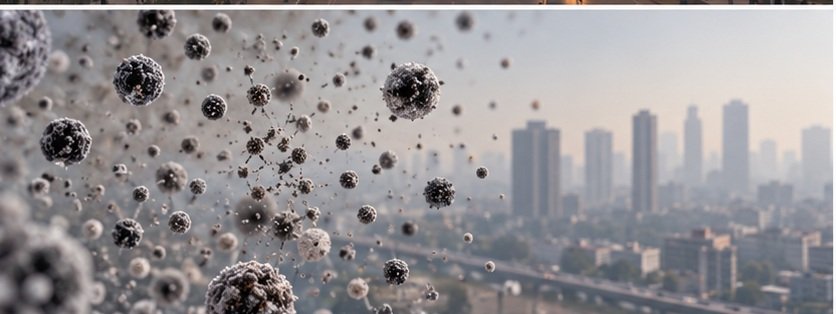
PM2.5 is one of the most important air pollutants for understanding both air quality and health. These microscopic particles are 2.5 micrometres or smaller in diameter—small enough to travel deep into the lungs, with some components able to enter the bloodstream. PM2.5 can come directly from sources such as vehicle exhaust, industry, fuel and biomass burning, wildfires and dust-related combustion, while other particles form in the atmosphere through chemical reactions involving gases released by traffic, power generation, agriculture and industry. Because PM2.5 can remain airborne and travel considerable distances, pollution measured in a city may come from both local and regional sources. This article explains what PM2.5 is, where it comes from, how it can affect health, how it influences the Air Quality Index (AQI), and what PM2.5 readings mean in everyday life.
What is PM2.5?
PM2.5 is the name used for extremely small particles floating in the air. Each is 2.5 micrometres wide or smaller. A micrometre is one-thousandth of a millimetre, so many PM2.5 particles are roughly 30 times smaller than the width of a human hair. Because they are so small, they can stay in the air for long periods and can travel deep into the lungs when we breathe.
PM2.5 is not one chemical. It is a mixture that can contain soot or black carbon, organic material, sulfates, nitrates, ammonium, metals, mineral components and other substances. Its composition depends on sources, atmospheric chemistry, weather and geography.
Where does PM2.5 come from?
Some PM2.5 is released directly in smoke and exhaust from vehicles, power plants, factories, household fuel burning and wildfires. But some fine particles are actually created after gases have entered the air. Those gases react with other chemicals and form new tiny particles. Scientists call these “secondary particles.”
That means reducing fine-particle pollution is not only about controlling visible smoke or dust. It can also require reducing gases such as sulfur dioxide, nitrogen oxides and ammonia that can later turn into particles in the atmosphere.
Why PM2.5 matters for health
WHO’s 2021 global air-quality guidelines reflect evidence that adverse health effects occur at lower concentrations than previously understood. Long-term particulate exposure is associated with major noncommunicable diseases, including cardiovascular and respiratory disease and lung cancer.
Particle size matters because fine particles can reach the lower airways and lungs. The biological pathways under study include inflammation and oxidative stress, effects on the autonomic nervous system, and in some cases movement of particle components or associated signals beyond the lungs.
PM2.5 concentration is not the same as AQI
PM2.5 concentration is usually shown as micrograms per cubic metre of air, written as µg/m³. In simple terms, this tells us how much fine-particle material is present in a given volume of air. The Air Quality Index (AQI) is different: it converts a measured pollution concentration into an easier-to-read health category or index number.
Different countries use different AQI systems. Therefore the same PM2.5 concentration does not necessarily produce the same displayed index number on every national scale. AirQualityIndex.org should always make clear which methodology is being used rather than implying that one 0–500 system is universal.
Why PM2.5 can travel far
Fine particles can remain airborne long enough to be transported across cities, states and national borders. Wildfire smoke is a striking example, but regional haze and secondary aerosol pollution can also travel hundreds of kilometres.
This is why city-level air quality cannot always be explained by emissions within the city boundary. Regional airshed management is often necessary.
Outdoor PM2.5 can become an indoor problem
Outdoor particles enter buildings through open doors and windows, mechanical ventilation and infiltration through gaps and cracks. Indoor concentrations depend on the building, ventilation, filtration and indoor particle sources such as cooking, smoking and combustion.
During severe outdoor episodes, indoor filtration can reduce particle concentrations, but it should complement source control and sensible ventilation decisions rather than be treated as a universal cure.
How to use PM2.5 information
Look at the concentration, the AQI category, the observation time and the source. Short spikes and long-term exposure answer different health questions. During severe episodes, reducing the duration and intensity of outdoor exertion can lower inhaled dose, particularly for people at greater risk.
For a complete interpretation, PM2.5 should be viewed alongside PM10, ozone, nitrogen dioxide and local source information when those data are available.
Explore Related Air Quality Resources
AQI Explained · Pollutants · AQI Calculator · AQI Near Me · Wildfire Smoke · Indoor Air Quality
References
World Health Organization — WHO Global Air Quality Guidelines — https://www.who.int/publications/i/item/9789240034228
US EPA — Why is Smoke a Health Concern? — https://www.epa.gov/wildfire-smoke-course/why-smoke-health-concern
US EPA — Indoor Air Quality and Changing Outdoor Environments — https://www.epa.gov/indoor-air-quality-iaq/indoor-air-quality-and-changing-outdoor-environments