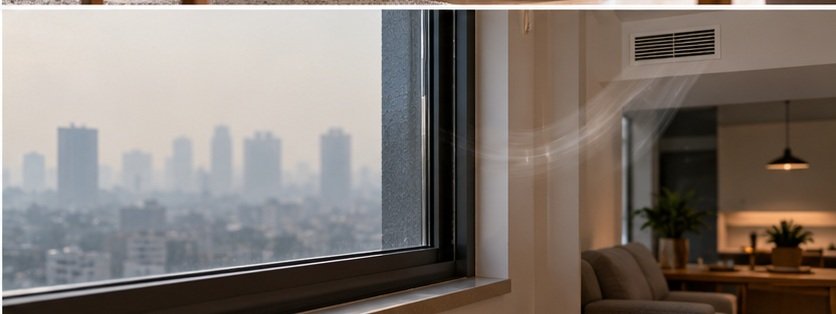
Outdoor air pollution does not always stay outdoors. Fine particulate matter, especially PM2.5, can enter homes through open doors and windows, ventilation systems and small gaps in the building, meaning indoor air quality can sometimes be strongly influenced by conditions outside. How much pollution gets indoors depends on factors such as the building, ventilation, filtration, weather and indoor activities such as cooking, smoking or burning fuels. During severe pollution episodes—including traffic pollution, winter smog and wildfire smoke—understanding this outdoor-to-indoor connection becomes particularly important. This article explains how PM2.5 enters and behaves inside homes, why indoor levels can differ from outdoor readings, and practical ways to reduce exposure when outdoor air quality is poor.
Outdoor air does not stop at the front door
Indoor air quality is shaped by both indoor sources and the outdoor environment. Outdoor pollution can enter through open windows and doors, mechanical ventilation systems and infiltration through cracks, joints and other openings in the building envelope.
EPA notes that changing outdoor conditions can worsen indoor air quality. The amount that enters depends on weather, building tightness, ventilation design, filtration, pressure differences and occupant behaviour.
Why two neighbouring homes can have different indoor PM2.5
A tightly sealed modern building with effective filtration can behave very differently from an older, leakier building. Window opening, exhaust fans, air-conditioning configuration and filter efficiency can all change the relationship between outdoor and indoor concentrations.
Indoor sources matter too. Cooking, smoking, candles, incense and some heating or combustion activities can produce particles indoors. A high indoor reading therefore should not automatically be attributed to outdoor pollution.
central heating and air-conditioning systems can either help or complicate the picture
Central heating and air-conditioning systems can also affect indoor air. Some bring outdoor air inside, while others mainly recirculate indoor air through a filter. A better filter can remove more particles, but it must be suitable for the system and the fan must actually be running for filtration to occur.
If a home has a central ducted heating or air-conditioning system, the U.S. Environmental Protection Agency (EPA) recommends a filter rated MERV 13, or the highest-efficiency filter the system can safely handle. MERV is simply a rating used for filters fitted inside central air systems: a higher number generally means better removal of small particles. A portable room air purifier is different. These commonly use a HEPA (High-Efficiency Particulate Air) filter and are designed to clean the air in one room or area.
What happens during wildfire smoke and severe smog
During a severe outdoor PM2.5 episode, infiltration can raise indoor particle levels even when windows remain closed. Creating a cleaner-air room can therefore be useful: reduce avoidable particle sources, limit polluted-air entry where practical, and use appropriately sized filtration.
This does not mean buildings should be permanently sealed. Ventilation is essential for controlling many indoor pollutants. The correct strategy depends on outdoor conditions and indoor sources.
Filtration is a supplement, not a substitute
EPA emphasizes source control and ventilation with clean outdoor air as primary indoor-air strategies, with filtration as an effective supplement. No portable cleaner removes every pollutant.
Particle filters and gas-removal media solve different problems. A HEPA purifier can be very effective for particles yet do little for many gases unless the device also contains suitable gas-phase media.
A practical decision framework
When outdoor AQI is good, appropriate ventilation may improve indoor air by diluting indoor-generated pollutants. When outdoor particle pollution is severe, uncontrolled ventilation can increase indoor PM2.5. During those periods, filtration and selective ventilation become more important.
Explore Air Quality Related Resources
· AQI Near Me · PM2.5 Explained · AQI Explained Air Purifier Guide · Wildfire Smoke · Data & Methodology
References
US EPA — Indoor Air Quality and Changing Outdoor Environments — https://www.epa.gov/indoor-air-quality-iaq/indoor-air-quality-and-changing-outdoor-environments
US EPA — Guide to Air Cleaners in the Home — https://www.epa.gov/indoor-air-quality-iaq/guide-air-cleaners-homeUS EPA — How to Create a Cleaner Air Room at Home — https://www.epa.gov/wildfires/how-create-cleaner-air-room-home