
Children are particularly vulnerable to air pollution because their lungs and other body systems are still developing, they breathe more air relative to their body size than adults, and they often spend more time being physically active outdoors. This guide explains how pollutants such as PM2.5, ozone and nitrogen dioxide can affect children, why exposure can vary dramatically with location and activity, and how parents, schools and caregivers can use local air-quality information to make practical decisions without unnecessarily restricting healthy outdoor activity.
Children are not simply smaller adults
Air pollution affects people of every age, but childhood is a period of rapid lung, immune and neurological development. Children also spend time outdoors, play vigorously and may breathe more air relative to their body size than adults. These biological and behavioural factors can increase vulnerability when pollution is high.
That does not mean every polluted day causes visible illness, nor that AQI predicts an individual child’s outcome. It means parents, schools and communities should take air quality seriously as one part of a healthy environment—especially for children with asthma or other chronic conditions.
Key takeaways
- Developing lungs and higher activity levels can make children more susceptible to polluted air.
- PM2.5, ozone, nitrogen dioxide, wildfire smoke and other pollutants affect health through different pathways.
- Children with asthma or chronic disease may need earlier or more individualized precautions.
- Outdoor activity decisions should consider local AQI, duration and exercise intensity—not just whether the sky looks hazy.
- Indoor air can be improved through source control, appropriate ventilation and filtration.
- Schools can reduce exposure through activity planning, ventilation/filtration maintenance and no-idling/source-control policies.
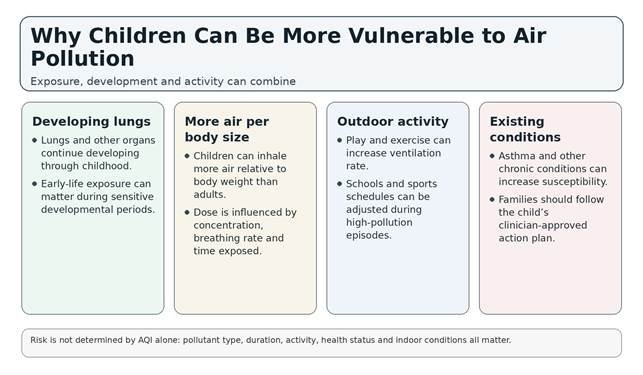
Figure: Why children can be more vulnerable to air pollution.
Why developing lungs matter
The respiratory system continues to grow and mature through childhood and adolescence. Exposure during developmental periods can therefore have different implications from the same exposure in a healthy adult. Epidemiological research has associated long-term air-pollution exposure with effects on respiratory health and lung function in children.
A Delhi study indexed by the U.S. EPA’s HERO database, for example, examined children aged 9–17 and reported associations between air pollution exposure and respiratory outcomes. Another peer-reviewed Delhi school study found higher respiratory symptoms in areas with higher particulate concentrations. Individual studies have limitations, but they fit a much broader evidence base that supports protecting children from avoidable air pollution.
Children may receive a higher dose during activity
Pollution risk is partly about dose: concentration multiplied by the amount of polluted air inhaled over time. Children running, playing football or cycling breathe faster and more deeply than when sitting indoors. If outdoor PM2.5 or ozone is high, strenuous activity can increase inhaled dose.
This is why air-quality guidance often distinguishes ordinary activity from prolonged or heavy exertion. The goal is not to keep children indoors unnecessarily; physical activity is essential for health. The practical approach is to move, shorten or reduce the intensity of outdoor activity when pollution reaches levels where local health guidance recommends precautions.
PM2.5: the pollutant families hear about most
PM2.5 consists of fine particles small enough to penetrate deep into the respiratory tract. Sources include combustion, traffic, industry, power generation, household fuels and wildfire smoke; secondary particles also form in the atmosphere from gaseous precursors.
PM2.5 concentrations can vary dramatically by season and weather. Delhi’s winter pollution illustrates how emissions, shallow mixing layers and regional transport can combine to produce prolonged episodes. In wildfire-prone regions, a smoke plume can create an abrupt spike. Parents should therefore use current local data rather than assuming yesterday’s conditions still apply.
Ozone, nitrogen dioxide and other pollutants
Not every high-pollution episode is driven by particles. Ground-level ozone forms through atmospheric reactions involving precursor pollutants and sunlight, and can irritate airways. Nitrogen dioxide is strongly associated with combustion sources, including road traffic and some indoor appliances. Carbon monoxide, sulfur dioxide and other pollutants have their own health effects and sources.
The practical implication is that “air pollution” is not a single substance. A particle purifier can reduce airborne particles but does not solve every gas problem. Likewise, opening windows may reduce an indoor-generated pollutant on a clean day but worsen indoor PM2.5 when outdoor smoke is severe.
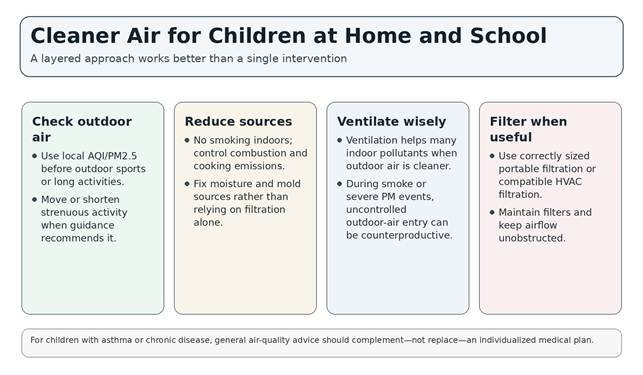
Figure: Practical cleaner-air actions for children at home and school.
Asthma and other susceptible children
Children with asthma can be particularly sensitive to air pollution. Polluted air may aggravate symptoms in some children, and wildfire smoke can be especially challenging. Families should maintain prescribed medicines and follow a clinician-approved asthma action plan. General AQI advice cannot replace individualized medical guidance.
If a child develops severe breathing difficulty, bluish lips, unusual lethargy, chest pain or another urgent symptom, seek appropriate medical care. An air-quality website is useful for exposure decisions, not for diagnosing or treating illness.
Air quality at school
Schools influence exposure because children spend a large part of the day there. Outdoor pollution can enter classrooms, while indoor sources such as cleaning products, science activities, art materials, cooking, moisture problems and nearby idling vehicles can add to the indoor mixture.
A strong school approach combines outdoor AQI awareness with building management. Filters should be maintained, ventilation should be operated appropriately for outdoor conditions, moisture problems should be corrected, and vehicle idling near air intakes should be discouraged. During smoke events, schools may need to shift activities indoors and operate filtration more intensively.
Should children stay indoors whenever AQI rises?
Not automatically. Decisions should follow the local AQI system and its health messages, with special attention to children who are unusually sensitive. The duration and intensity of activity matter. A short walk and a two-hour competitive practice do not create the same inhaled dose.
Schools and families can use a graduated response: check current conditions; identify the pollutant driving AQI; reduce prolonged strenuous activity as guidance recommends; move activities to a cleaner indoor space when needed; and reassess later because air quality can change within hours.
Making indoor air cleaner for children
Indoor air management begins with source control. Do not smoke indoors. Use kitchen exhaust when cooking. Address moisture and mold at the source. Maintain combustion appliances. Choose cleaning and household products thoughtfully.
Ventilation is important when outdoor air is suitable, because it dilutes many indoor-generated pollutants. But during severe PM2.5 or wildfire smoke, uncontrolled ventilation can bring outdoor particles inside. In those periods, recirculation and particle filtration can be more useful until outdoor conditions improve. A correctly sized portable air cleaner can reduce airborne particles in a bedroom or play area, but it does not remove every gas or fix a source problem.
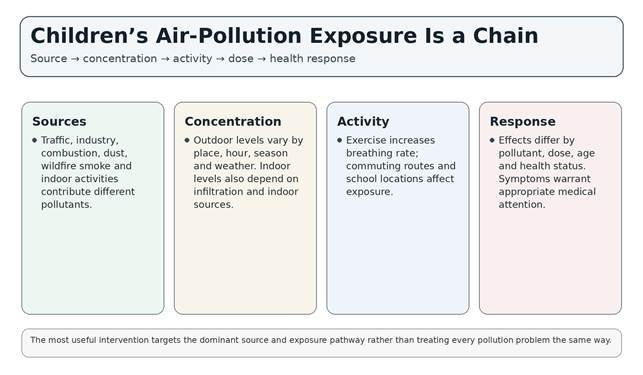
Figure: How pollution sources become personal exposure and health risk for children.
Portable air cleaners in a child’s room
If particle pollution is the concern, focus on verified clean-air delivery rather than marketing language. CADR indicates how much filtered air a unit delivers for particles. Select enough capacity for the room and ceiling height, keep intake and outlet airflow unobstructed, and use a fan setting that provides meaningful filtration.
Avoid devices intentionally producing ozone. Keep cords and equipment safely positioned around young children, and follow manufacturer instructions. Filter replacement matters: a neglected unit is not a permanent solution.
Traffic, school routes and everyday exposure
Exposure can vary over short distances. Busy roads, bus queues and idling zones can create higher near-road concentrations than a neighbourhood background monitor indicates. When practical, walking or cycling routes set back from heavy traffic may reduce direct exhaust exposure without eliminating physical activity.
Timing also matters. Pollution peaks can follow rush-hour traffic, winter inversions, dust events or afternoon ozone formation depending on location. AirQualityIndex.org city and near-me information can help identify current conditions, while local agencies may provide higher-resolution alerts and school-specific guidance.
A practical family air-quality plan
A useful plan is simple enough to follow. Know which child has asthma or another condition requiring special precautions. Bookmark local AQI. Understand the school’s pollution policy. Keep prescribed medicines available. Know which room at home can be made cleaner during smoke or severe PM episodes. Maintain filters before the pollution season rather than searching for them during a crisis.
Most importantly, avoid turning air quality into constant anxiety. The objective is informed risk reduction: use good data, take proportionate action when pollution is high, and preserve healthy outdoor activity when conditions are acceptable.
Pregnancy and the earliest life stages
Air-pollution protection begins before a child starts school. WHO’s current health evidence identifies pregnant women among populations at greater risk from air pollution. Prenatal and early-life exposure research is one reason clean-air policy is framed as a life-course issue rather than only a problem for people who already have respiratory disease. Practical advice should remain proportionate: reduce avoidable exposure, follow local alerts and seek individualized medical advice when needed.
Indoor cooking and combustion deserve attention
Families sometimes focus exclusively on outdoor AQI while overlooking indoor combustion. Frying and high-temperature cooking can generate particles; unvented or poorly vented combustion can add gases and particles. A working range hood vented outdoors can be valuable. In homes using solid fuels or other high-emission cooking/heating methods, source improvement can have far greater impact than a small portable purifier.
Air-quality monitors in homes and schools
A monitor can make invisible pollution easier to understand, but a number on a screen needs context. Consumer PM sensors can be useful for trends—such as seeing whether cooking causes a spike or whether a purifier lowers particles—but readings can differ by sensor and aerosol type. Carbon dioxide monitors are often used as a ventilation proxy in occupied spaces, but CO2 is not a complete measure of indoor-air safety and does not directly represent PM2.5 or VOCs.
Equity and unequal exposure
Children do not experience air pollution equally. Housing quality, traffic proximity, access to cooling and filtration, school building condition and household resources all influence exposure and the ability to respond. Public-health strategies therefore need more than individual consumer advice. Cleaner transport, emissions control, healthy schools and access to cleaner-air spaces are structural measures that can reduce exposure across communities.
What parents should look for in an AQI app or website
For family decisions, the most useful air-quality service should identify location, observation time, pollutant and data source rather than showing an unexplained coloured number. Check whether the AQI is current, whether PM2.5 or another pollutant is driving it, and whether the reading is observed or modelled. A stale value can be misleading during rapidly changing smoke, dust or inversion events.
Parents do not need to become atmospheric scientists. A simple routine works: check the current AQI before a long outdoor activity, read the accompanying health message, consider the child’s health and the intensity of the planned activity, and check again if conditions are changing. AirQualityIndex.org should support this process by connecting Knowledge articles directly to local observations and transparent source timestamps.
Community and policy measures still matter
Household actions are valuable, but children cannot filter their way out of a polluted city. Durable protection also depends on cleaner transport, industrial emissions control, dust management, clean household energy, wildfire prevention and resilient school buildings. Monitoring networks matter because they reveal when and where exposure is highest. Public reporting should include observation time and pollutant so families can make informed decisions. For AirQualityIndex.org, this is an important editorial principle: personal-protection advice should sit alongside explanations of the emission sources and policy measures that can reduce pollution for everyone.
A child-friendly way to communicate air quality
Air-quality information should guide children without frightening them. Families can explain that some days the air contains more invisible pollution, just as some days are hotter or stormier, and that adults can change activities to reduce exposure. Older children can learn to read AQI categories and understand why a sports practice is moved indoors. This turns AQI into practical environmental literacy rather than a source of anxiety. Schools can reinforce the same message by explaining activity changes and emphasizing that restrictions are temporary and based on current conditions.
When indoor and outdoor priorities conflict
A closed room can reduce outdoor PM2.5 but accumulate carbon dioxide, heat, humidity or pollutants from indoor sources. Conversely, opening windows can improve ventilation but import outdoor particles when AQI is poor. There is no permanent rule that windows should always be open or always be closed.
During a severe particle episode, reducing outdoor-air entry and filtering recirculated air may be appropriate for a period. When outdoor air improves, ventilation can again help dilute indoor-generated pollutants. Schools need the same flexible thinking at larger scale: outdoor conditions, occupancy, HVAC design and indoor sources all influence the best operating mode.
Conclusion
Children deserve cleaner air at home, at school and outdoors. Their developing lungs, activity patterns and underlying health can make pollution more consequential, but many exposure pathways are modifiable. Better information, source control, sensible activity planning, ventilation and filtration can work together.
Next on AirQualityIndex.org: read PM2.5 Explained, check Air Quality Near Me, and explore the guide to how outdoor air pollution gets inside your home.
Suggested internal links
- Air Quality Near Me
- PM2.5 Explained
- Does Outdoor Air Pollution Affect Indoor Air Quality?
- Air Quality Data & Methodology
Authoritative references
- WHO — Health effects of air pollution: evidence and implications (2026)
- CDC — Wildfire Smoke and Children
- U.S. EPA HERO — Air pollution and its impact on lung function of children in Delhi
- U.S. EPA HERO — Air pollution and respiratory health of school children in Delhi
- U.S. EPA — Guide to Air Cleaners in the Home