
A technical guide to the particles and gases behind air-quality measurements, their sources, atmospheric behaviour and relationship with AQI.
Last reviewed: October 2026
Air pollution is a mixture, not a single substance
Air pollution is a changing mixture of particles and gases produced by transport, power generation, industry, construction, agriculture, household fuel use, fires, natural dust and atmospheric chemistry. Two places with a similar AQI can therefore have very different pollution profiles.
The pollutants most commonly used for air-quality assessment include PM₂.₅, PM₁₀, ozone (O₃), nitrogen dioxide (NO₂), sulfur dioxide (SO₂) and carbon monoxide (CO). Other pollutants — including lead, volatile organic compounds, ammonia, black carbon and hazardous air pollutants — can also be important depending on location and emission sources.
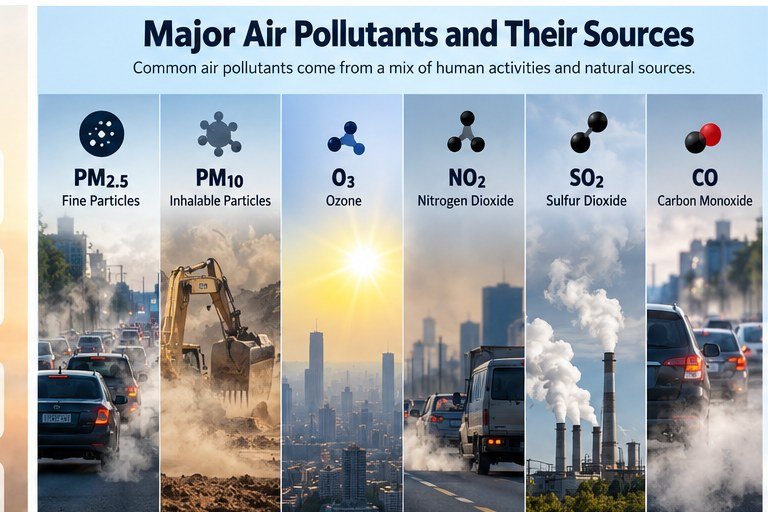
Major air pollutants at a glance
| Pollutant | What it is | Important sources | Why it matters |
|---|---|---|---|
| PM₂.₅ | Fine particles ≤2.5 µm | Combustion, traffic, industry, fires, secondary aerosols | Can penetrate deep into the lungs; major health indicator |
| PM₁₀ | Inhalable particles ≤10 µm | Dust, roads, construction, agriculture, combustion | Includes PM₂.₅ and larger inhalable particles |
| O₃ | Ground-level ozone | Forms from precursor pollutants in sunlight | Major component of photochemical smog |
| NO₂ | Nitrogen dioxide | Traffic, power generation, industry, heating | Respiratory pollutant and ozone/particle precursor |
| SO₂ | Sulfur dioxide | Sulfur-containing fuels, industry, shipping, volcanoes | Respiratory irritant and sulfate-particle precursor |
| CO | Carbon monoxide | Incomplete combustion | Reduces oxygen transport in the body |
PM₂.₅ — fine particulate matter
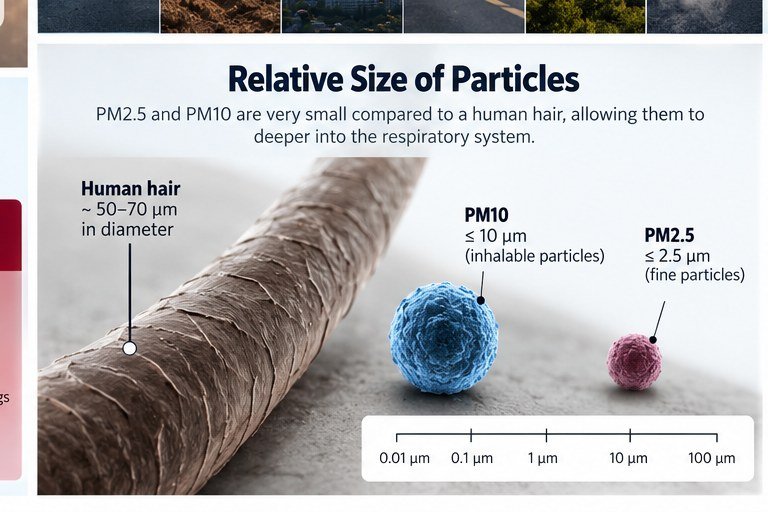
PM₂.₅ means particulate matter with an aerodynamic diameter of 2.5 micrometres or smaller. It can be primary, emitted directly from combustion, vehicles, industry, fires and other sources, or secondary, formed in the atmosphere when precursor gases react chemically.
This distinction matters: high PM₂.₅ at a monitoring location does not necessarily mean all of the particles were emitted locally. Secondary particles and transported pollution can contribute substantially.
PM₁₀ — inhalable particulate matter
PM₁₀ consists of particles with aerodynamic diameters of 10 micrometres or smaller. It includes the PM₂.₅ fraction plus larger inhalable particles. Sources can include road and soil dust, construction, mining, agriculture, sea spray, biological material, industry and combustion.
Ground-level ozone (O₃)
Ozone near the Earth's surface is different from the protective ozone layer high in the atmosphere. Ground-level ozone is largely a secondary pollutant. It forms when nitrogen oxides and volatile organic compounds react through atmospheric chemistry in the presence of sunlight. Because sunlight and meteorology are important, ozone often has strong daily and seasonal patterns and can peak away from the sources that emitted its precursors.
Nitrogen dioxide (NO₂)
NO₂ is a reactive gas associated with high-temperature combustion. Important sources include road vehicles, power plants, industrial combustion, heating and shipping. In cities it can be elevated near busy roads. NO₂ is itself a pollutant and also participates in atmospheric chemistry that contributes to ground-level ozone and secondary particulate matter.
Sulfur dioxide (SO₂)
SO₂ is produced mainly when sulfur-containing fuels or materials are burned or processed. Sources can include coal- and oil-fired power generation, industrial boilers, metal smelting, petroleum refining, shipping and volcanic activity. In the atmosphere, SO₂ can be converted into sulfate particles and therefore contribute to secondary PM.
Carbon monoxide (CO)
CO is a colourless, odourless gas produced by incomplete combustion. Sources include vehicles, generators, furnaces, biomass burning, fires and poorly ventilated cooking or heating. CO differs from many common pollutants because its principal toxic mechanism is interference with oxygen transport in the blood. High indoor concentrations can be acutely dangerous.
Other important pollutants
Volatile organic compounds (VOCs)
A large family of compounds from fuels, solvents, paints, industry, vegetation and combustion. Some have direct health effects; others contribute to ozone and secondary organic aerosol.
Ammonia (NH₃)
Important sources include livestock, manure and fertilizer. Atmospheric ammonia can react with acids to form ammonium salts that contribute to PM₂.₅.
Black carbon
A light-absorbing component of particulate matter produced by incomplete combustion, including diesel, biomass burning and solid-fuel use. It is relevant to both health and climate.
Lead and toxic metals
Lead and other metals may occur in airborne particulate matter near industrial, smelting, recycling and contaminated-dust sources. Regulatory treatment varies by jurisdiction.
Primary versus secondary pollutants
Primary pollutants are emitted directly, such as CO from incomplete combustion, NOₓ from engines, SO₂ from sulfur-containing fuels and dust from construction. Secondary pollutants form after emission through atmospheric reactions; examples include ozone, sulfate, nitrate and secondary organic aerosol.
This is one reason air pollution crosses administrative boundaries. Weather and atmospheric chemistry can transform and transport pollution across cities, states and countries.
Pollutant concentration is not the same as AQI
A concentration is a physical measurement such as PM₂.₅ = 35 µg/m³. An AQI is an index calculated from pollutant concentration according to a defined methodology. Different jurisdictions can use different breakpoints, averaging periods, pollutants, units and health categories.
Use the AQI Calculator to explore supported methods, and Air Quality Explained for interpretation.
Why the dominant pollutant matters
Two cities can display a similar headline AQI while one is dominated by PM₂.₅ and the other by ozone. The chemistry, sources, timing and exposure considerations can differ. Wherever reliable data are available, looking at individual pollutant values provides useful context beyond the headline AQI.
Why levels change during the day
Traffic patterns, atmospheric mixing, temperature inversions, sunlight, wind, rainfall, wildfires and dust storms can all change pollutant concentrations. Air quality may therefore change substantially within a few hours. A station observation is also local to that monitoring site, while a model estimate represents an area or grid cell.
WHO guideline levels
WHO's Global Air Quality Guidelines provide health-based reference concentrations for PM₂.₅, PM₁₀, O₃, NO₂, SO₂ and CO. They are recommendations rather than universal legal limits; countries set their own standards.
| Pollutant | Averaging period | WHO 2021 AQG |
|---|---|---|
| PM₂.₅ | Annual / 24-hour | 5 / 15 µg/m³ |
| PM₁₀ | Annual / 24-hour | 15 / 45 µg/m³ |
| O₃ | Peak season / 8-hour | 60 / 100 µg/m³ |
| NO₂ | Annual / 24-hour | 10 / 25 µg/m³ |
| SO₂ | 24-hour | 40 µg/m³ |
| CO | 24-hour | 4 mg/m³ |
Scientific & technical references
- WHO — Global Air Quality Guidelines ↗
- WHO — Types of Pollutants ↗
- WHO — Air Quality Standards Database ↗
- U.S. EPA — Criteria Air Pollutants ↗
- U.S. EPA — Particulate Matter ↗
- U.S. EPA — Ground-level Ozone ↗
- U.S. EPA — Nitrogen Dioxide ↗
- U.S. EPA — Sulfur Dioxide ↗
- U.S. EPA — Carbon Monoxide ↗
- European Environment Agency — Air Pollution ↗