
Understand moisture output before comparing tanks, mist and marketing claims.
A humidifier must add enough water to offset the moisture carried away by ventilation and other losses, but not so much that condensation or microbial growth becomes likely. Room size and ceiling height define air volume; outdoor and indoor moisture conditions determine the ventilation-related loss. This guide shows what a preliminary calculation can—and cannot—tell you.
Quick answer
Understand moisture output before comparing tanks, mist and marketing claims. Start with the measurements and published ratings described below; avoid treating illustrative numbers as guarantees of installed performance.
The distinction between tank and output
A two-litre tank is stored water, not a two-litre-per-hour output rating. Compare actual output in mL/h or L/day, the rated operating conditions and how the humidistat controls delivery. Larger tanks can reduce refilling without increasing moisture addition rate.
Choose an appropriate output for the expected load and a control that can turn down or stop as conditions change. A fixed-output unit in a small, well-sealed bedroom may overshoot a safe humidity target.
A transparent moisture-balance equation
For a first-pass ventilation estimate, moisture replacement rate in g/h is Q × (ρtarget − ρsupply), where Q is incoming dry-air volume in m³/h and ρ represents absolute humidity in g/m³. If outdoor air is drier, the difference is positive. The calculation ignores many other moisture sources and sinks, so it is a planning component, not a measured whole-room requirement.
Example: a 20 m² room with a 2.5 m ceiling has 50 m³ of volume. At 0.5 air changes/hour, Q = 25 m³/h. If target air contains 8 g/m³ and incoming air contains 4 g/m³, the ventilation-related demand is 25 × (8 − 4) = 100 g/h, approximately 0.10 L/h of water. These densities are illustrative assumptions, not readings from the room.
Comparison at a glance
| Measure | What it means | Buying implication |
| mL/h | Water added per hour | Compare to estimated load |
| Tank volume | Stored water | Refill frequency |
| RH setpoint | Control target | Avoid over-humidifying |
| ACH assumption | Outdoor-air replacement | Changes estimated load |
Why relative humidity alone is insufficient
Relative humidity is temperature dependent. Air at 40% RH in a warm room can hold more water vapour than air at 40% RH in a cold room. A reliable calculation converts temperature and RH into absolute humidity or humidity ratio before subtracting values.
A hygrometer and thermometer help establish conditions; they do not directly measure infiltration rate. If ACH is unknown, any resulting moisture demand must be labelled as an assumed scenario.
Target humidity and condensation
EPA advises not humidifying above 50% RH and reducing output if windows, walls or furnishings become damp. In cold climates, condensation on poorly insulated surfaces may occur even before a central sensor reaches 50%.
A target around 30–50% RH is a practical reference, not an instruction to force every building to 50%. Adjust to avoid condensation and follow local building or healthcare guidance when relevant.
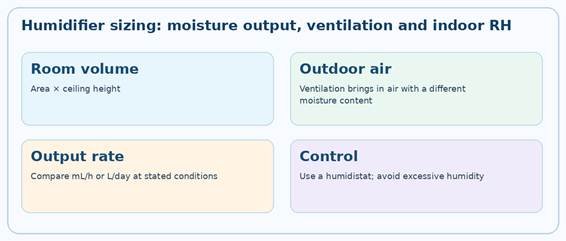
Figure: Original editorial decision illustration; conceptual guidance, not independent laboratory test results.
Technology and maintenance trade-offs
Ultrasonic devices produce fine droplets and may disperse dissolved minerals from the water; evaporative units use a wetted medium and fan; steam units heat water and may create burn hazards. Maintenance, water quality, noise and power use matter alongside output.
EPA recommends regular cleaning and appropriate water management. Use low-mineral or distilled water where manufacturer guidance supports it, especially for ultrasonic devices, and never assume an antimicrobial marketing label removes the need to clean.
How to compare two models
Record maximum and controllable minimum output, humidity sensor location, tank capacity, refill convenience, noise at the intended setting, cleaning access, water requirements and local electrical approvals. The better option is one that can maintain the target without wetting nearby surfaces.
Monitor RH and surfaces after installation. If the unit runs continuously but RH remains low, reassess air leakage, outdoor conditions and output; if RH rises too high, reduce the setpoint or duty cycle.
A practical decision checklist
• Record the actual room temperature, relative humidity and the operating schedule before choosing equipment.
• Compare the same units and test conditions; do not mix marketing maximums with independent rated performance.
• Confirm maintenance access, electrical compatibility, local warranty, replacement parts and safe installation.
• Recheck results after installation using measurements, not only the calculated or advertised output.
Common questions
Does a larger capacity always mean a better purchase?
No. Controllability, actual operating conditions, noise, energy consumption and maintenance can matter more than a headline maximum.
Can a calculator guarantee real-world performance?
No. It provides a transparent preliminary estimate or published selection band. Actual delivery depends on the installed equipment and site conditions.
Can outdoor AQI alone determine this equipment choice?
No. AQI does not describe room moisture, airflow, duct losses or the complete indoor environment.
What should I verify before ordering?
The exact model number, published rating method, local power and safety requirements, delivery, return terms and warranty.
Use the Air Quality Advisor
For a transparent preliminary calculation, use the Air Quality Advisor. Confirm actual product specifications, test conditions and local installation requirements before purchase.
References and further reading
Affiliate disclosure
Some shopping links on AirQualityIndex.org may earn a commission at no additional cost to the visitor. Technical guidance and product suitability should not depend on commission rates.