Wildfire smoke can travel hundreds or even thousands of kilometres, affecting air quality far beyond the fire itself. Much of the health concern comes from fine particulate matter (PM2.5), which can penetrate deep into the lungs and make outdoor—and sometimes indoor—air unhealthy. This guide explains how wildfire smoke affects AQI, who may be most vulnerable, how smoke enters buildings, and practical steps you can take to reduce exposure at home, outdoors and while travelling.
Wildfire smoke is an air-quality problem far beyond the fire line
Wildfire smoke can travel hundreds or even thousands of kilometres, turning a fire in one region into an air-quality event in another. The most important pollutant for many smoke episodes is fine particulate matter, or PM2.5: particles with aerodynamic diameter of 2.5 micrometres or smaller. Their small size allows them to remain suspended, penetrate buildings and reach deep into the respiratory system. Smoke also contains gases and other combustion products, so a single AQI number cannot describe every component of the mixture.
For most readers, the useful question is not simply whether smoke is present. It is: how bad is the air where I am now, how long is the episode likely to last, what activities will increase my dose, and what can I do to create cleaner air? AirQualityIndex.org can connect this practical decision-making to current local AQI, while public-health agencies provide the health messages that accompany local AQI categories.
Key takeaways
- PM2.5 is usually the main pollutant used to track wildfire-smoke particle exposure.
- Smoke can infiltrate homes even when doors and windows are closed; filtration can substantially reduce indoor particles.
- Children, pregnant people, older adults and people with chronic heart or lung disease can be at greater risk.
- A correctly sized portable air cleaner, compatible HVAC filtration and a cleaner-air room are useful layers of protection.
- Source control still matters indoors: frying, smoking, candles and other particle sources can worsen indoor air during a smoke event.
- If outdoor exposure is unavoidable, follow local health guidance and use appropriate respiratory protection where recommended.
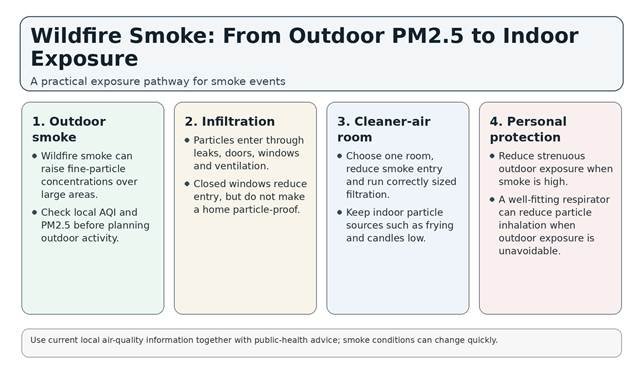
Figure: How wildfire smoke PM2.5 moves from outdoor air into indoor exposure and personal risk.
What is in wildfire smoke?
Wildfire smoke is a complex mixture created by incomplete combustion of vegetation, structures and other materials. Particle composition varies with fuel, fire temperature, atmospheric chemistry and the age of the smoke plume. PM2.5 receives particular attention because smoke episodes can produce large increases in fine-particle concentration and because PM2.5 is linked with respiratory and cardiovascular effects.
Smoke plumes also change as they travel. Sunlight and atmospheric reactions can transform gases and particles, while wind, mixing height and rainfall determine where concentrations accumulate or disperse. That is why a distant fire can sometimes produce worse measured PM2.5 in a downwind city than a casual look at the sky would suggest. Visibility and smell are useful warnings, but neither is a quantitative substitute for a monitor or AQI report.
How wildfire smoke changes AQI
AQI converts measured pollutant concentrations into a communication scale intended to help the public interpret health significance. During a smoke episode, PM2.5 frequently becomes the pollutant driving the AQI. The exact breakpoints and labels depend on the national AQI system, so readers should follow the health advice attached to the AQI used in their location.
AQI is most useful as a decision trigger. A rising value can prompt changes in outdoor exercise, school activities, work practices, ventilation and filtration. It should not be treated as a precise personal dose meter: two people in the same city may have different exposures because one is exercising outdoors while another is in a well-filtered building.
Why PM2.5 matters for health
Fine particles can reach deep into the lungs. Short-term smoke exposure can irritate eyes and airways and may aggravate asthma or other respiratory disease. The broader PM2.5 evidence base also links fine-particle exposure with cardiovascular effects. Risk depends on concentration, duration, activity level, underlying health and individual susceptibility.
People with asthma, chronic obstructive pulmonary disease, cardiovascular disease and other chronic conditions should pay particular attention to their clinician’s advice. Children, pregnant people and older adults are also among groups commonly identified as more susceptible. Severe breathing difficulty, chest pain or other urgent symptoms require appropriate medical attention rather than self-management based only on an AQI website.
How much outdoor smoke gets indoors?
Closing windows and doors reduces smoke entry, but a home is not airtight. Particles can enter through cracks, door openings, mechanical ventilation and other leakage pathways. EPA notes that during wildfire smoke events, indoor PM2.5 with windows and doors closed but without portable air cleaning is often around 55–60% of outdoor levels on average, with very wide variation among buildings.
This explains why staying indoors is helpful but not sufficient in every building. A leaky house, frequent door opening or an exhaust fan that pulls replacement air through cracks can allow more smoke indoors. Conversely, a relatively tight building with effective filtration can maintain a much lower particle concentration.
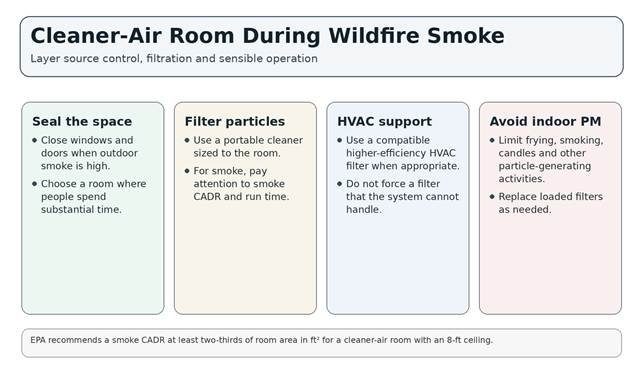
Figure: How to create a cleaner-air room during wildfire smoke using source control and filtration.
Create a cleaner-air room
A cleaner-air room is a practical strategy when whole-home filtration is not available. Choose a room where household members can spend substantial time, keep windows and doors closed when outdoor smoke is high, reduce indoor particle-generating activities, and use appropriately sized filtration. Bedrooms are often logical because people spend many hours there.
EPA guidance for wildfire smoke recommends a portable air cleaner with a tobacco-smoke CADR at least two-thirds of the room area in square feet for an eight-foot ceiling. A 120-square-foot room therefore calls for roughly 80 cfm or more of smoke CADR. Higher ceilings increase the volume of air and justify additional capacity.
Portable air cleaners, HVAC filters and DIY filtration
A portable HEPA or other high-efficiency particle air cleaner can reduce indoor PM2.5 when its clean-air delivery is appropriate for the room. Higher fan speeds and longer run times generally filter more air. During severe smoke, filters may load faster than under normal conditions, so inspection and replacement can be needed sooner.
Central HVAC filtration can complement portable units. A higher-efficiency filter such as MERV 13 may help if the HVAC system is designed to handle it; forcing an incompatible high-resistance filter can impair system performance. EPA also recognizes properly constructed DIY air cleaners as an option when commercial cleaners are unavailable or unaffordable. They should be built and operated using current safety guidance and suitable components.
Should you open windows during wildfire smoke?
Ventilation is normally important for indoor pollutants, but wildfire smoke creates a trade-off. When outdoor PM2.5 is much worse than indoor air, opening windows can rapidly increase indoor particle concentration. When the plume passes and outdoor air becomes cleaner, ventilation can help remove pollutants that accumulated indoors.
This is where live local AQI becomes useful. Rather than following a fixed rule such as “never open the windows,” compare outdoor conditions over time and use local public-health guidance. If you have a reliable indoor particle monitor, it can add another layer of information, although consumer sensors have limitations and should be interpreted carefully.
Outdoor activity, masks and commuting
Dose increases when both pollution concentration and breathing rate rise. Strenuous outdoor exercise during heavy smoke can therefore increase inhaled particles. Schools, athletes and outdoor workers should use local smoke guidance to adjust activity.
When exposure cannot be avoided, a well-fitting particulate respirator can reduce inhalation of airborne particles when used correctly. Loose face coverings do not provide the same protection. Respirators do not remove all gases in wildfire smoke, and fit, comfort, medical suitability and local occupational rules matter. People with medical concerns should follow professional advice.
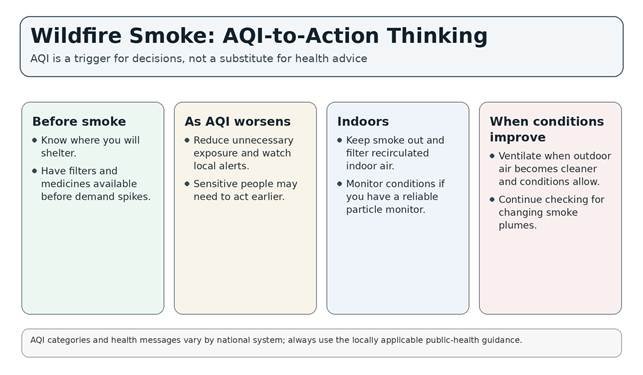
Figure: Practical AQI-to-action framework for wildfire smoke episodes.
Common mistakes during smoke episodes
One common mistake is buying a purifier based only on a “HEPA” label while ignoring CADR and room size. A very efficient filter with weak airflow may deliver too little clean air for a large room. Another is placing the unit behind furniture or running it only briefly on its lowest speed during severe smoke.
A third mistake is creating indoor particles while trying to shelter from outdoor smoke. Frying, smoking, incense and candles can all add particles. Finally, do not assume that odor removal equals particle removal. Activated carbon can help with selected gases and odors, while particle filtration addresses PM; these are different performance problems.
After the smoke clears
When outdoor air improves, ventilate if conditions and temperature allow, inspect filtration equipment and replace heavily loaded filters. Clean settled ash carefully using methods that minimize resuspension. Continue to watch air quality because smoke plumes can return with changing winds.
Wildfire preparedness is easiest before a crisis. Knowing the cleanest room, having replacement filters, understanding the HVAC system and bookmarking a reliable AQI source can turn a rushed response into a planned one.
AQI Insight: conditions can change faster than a daily forecast
Smoke plumes are dynamic. Wind direction, fire behaviour and boundary-layer mixing can change concentrations within hours. A morning AQI reading should not automatically be used to plan an evening run or school event. Check current conditions again before prolonged outdoor activity, especially when a smoke plume is nearby or forecast uncertainty is high.
Technical note: indoor/outdoor ratios are building-specific
An indoor concentration equal to 55–60% of outdoors is a useful population-level reference from EPA’s wildfire guidance, not a guarantee for an individual home. Building leakage, exhaust fans, window opening, filtration, room volume and particle deposition all change the ratio. A low-cost indoor PM sensor can help identify trends in a particular home, but sensor quality and calibration vary.
Planning for power outages and heat
Wildfire events can coincide with extreme heat or power interruptions. Keeping windows closed is not safe if indoor temperatures become dangerously high. Public-health guidance may prioritize relocation to a cleaner-air or cooling centre when a home cannot be kept both cool and reasonably smoke-free. People using electrically powered medical equipment or filtration should include backup power and evacuation considerations in emergency planning.
For workplaces, schools and shared buildings
Larger buildings need a systems approach rather than simply placing one consumer purifier in a corridor. Facility managers should know outdoor-air controls, filter compatibility, air-handling schedules and which rooms can serve as cleaner-air spaces. During severe smoke, communication is also part of exposure control: occupants need to know which entrances to use, where filtered rooms are located and how outdoor work or sports will be modified.
Reading a smoke forecast without over-interpreting it
Forecast maps are valuable for planning, but smoke is one of the harder air-quality hazards to predict precisely at neighbourhood scale. Fire emissions can change rapidly, plume height affects where smoke travels, and local wind or terrain can concentrate or clear pollution. Treat a forecast as a planning tool and a current monitor as a reality check. If the forecast suggests a severe afternoon episode, prepare the cleaner-air room in advance, but verify current conditions before changing activities.
Satellite imagery can show the extent of smoke but does not directly tell you what a person is breathing at ground level. Likewise, a citywide AQI may not capture every local variation. The strongest decision combines several pieces of evidence: nearby monitoring, current AQI, official smoke forecasts, visibility and local health alerts.
Practical checklist before wildfire season
Before smoke arrives, identify the room that can be kept coolest and cleanest, measure it for purifier sizing, obtain replacement filters, and learn how your HVAC system recirculates air. Bookmark local AQI and emergency-alert sources rather than relying on social-media screenshots. If anyone in the household uses prescribed respiratory or cardiovascular medicines, keep an appropriate supply and follow the clinician’s plan. Households with pets should include them in the cleaner-air plan because they also inhale smoke. Finally, think about evacuation thresholds: filtration is not a reason to remain in a location that authorities say should be evacuated. A cleaner-air plan reduces exposure when sheltering is appropriate; it does not replace fire-safety instructions.
Wildfire smoke and indoor gases
Particle filtration is the main household intervention discussed during smoke because PM2.5 often drives health messaging, but wildfire smoke also contains gases. A HEPA filter does not remove gases simply because it removes particles efficiently. Some purifiers add activated carbon or other sorbent media, but performance depends on the gas, media type, mass of sorbent and contact time.
This is another reason source reduction and building strategy matter. Keeping smoke out reduces both particles and gases entering the home. If a purifier includes only a thin carbon sheet, do not assume it provides comprehensive protection against the gaseous components of wildfire smoke. Product claims should be evaluated separately for particles and gases.
Conclusion
Wildfire smoke management is a layered problem: know the outdoor air, reduce unnecessary exposure, limit smoke infiltration, create cleaner indoor air and use correctly sized filtration. No single purifier or AQI number can eliminate risk, but timely information and practical controls can meaningfully reduce exposure.
Next on AirQualityIndex.org: check Air Quality Near Me, read PM2.5 Explained, and use the indoor/outdoor air-quality guide to understand how outdoor pollution enters buildings.
Suggested internal links
- Air Quality Near Me
- PM2.5 Explained
- Does Outdoor Air Pollution Affect Indoor Air Quality?
- Air Quality Data & Methodology