Updated October 2026: This article was originally published in June 2022 and has been expanded with additional guidance on CADR, room size, AQI conditions, fan speed, energy use, placement and air purifier safety.
What kind of air purifier did you just buy for your house? Air purifiers can be useful for reducing airborne particles such as dust, pollen, smoke and fine particulate matter, but buying the right unit is only part of the job. How long you run it, the fan speed you choose, the size of the room and the amount of pollution entering or being generated indoors all affect the result.
If you have ever wondered whether you should leave an air purifier on all day, switch it off when you leave home, run it only at night or use the highest setting for a few hours, the answer is more practical than a fixed number of hours. In general, longer operating times and higher effective airflow filter more air. The goal, however, is not simply to keep a machine switched on: it is to deliver enough clean air to keep up with the pollution in the room.
For many homes, especially during high-PM2.5 days, wildfire smoke, heavy traffic pollution or periods with frequent indoor particle sources, continuous operation at an appropriate speed can make sense. On cleaner days, a lower fan setting or automatic mode may be sufficient if indoor particle levels remain low.
air-purifier-runtime-pm25-filtration.png
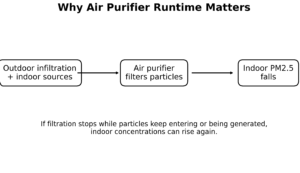
Figure 1. Filtration has to keep up with particles that continue to enter or be generated indoors.
How long should I run my air purifier?
Most of the time, the best approach is to run the purifier whenever the room is occupied or when particle pollution is present, rather than treating it as a device that cleans the room once and is then finished for the day. Dust and airborne particles are continually introduced through people, pets, cooking, cleaning, open doors and windows, and outdoor-air infiltration.
The U.S. Environmental Protection Agency notes that, generally, higher fan speeds and longer run times increase the amount of air filtered. A purifier set to a lower speed processes less air, while a higher speed usually passes more room air through the filter. That means a purifier can be left running for many hours but still underperform if it is undersized or operated at a speed that delivers too little clean air.
Continuous operation is particularly useful when outdoor particle pollution remains elevated for many hours. Even with windows closed, some outdoor PM2.5 can enter through normal building leakage and door opening. If filtration stops while the particle source continues, indoor concentrations can rise again.
This does not mean every purifier in every home must run at maximum speed 24 hours a day. A correctly sized unit may maintain good particle control at a quieter medium or low setting after an initial period at higher speed. A PM2.5 monitor can help show whether the selected setting is actually keeping indoor particles low.
A better way to think about runtime: CADR, room volume and ACH
The original version of this article focused mainly on hours of operation. A more useful way to judge purifier performance is to combine operating time with Clean Air Delivery Rate (CADR) and room volume. CADR describes how much contaminant-free air a purifier delivers for a particular particle category. A higher CADR generally means faster particle removal or the ability to serve a larger space.
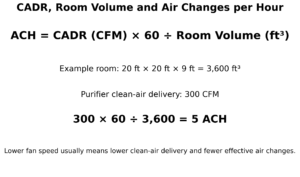
Air changes per hour (ACH) is another useful way to describe the relationship between clean-air delivery and the amount of air in the room. For a purifier rated in cubic feet per minute (CFM), a simple relationship is:
ACH = CADR (CFM) × 60 ÷ room volume (ft³)
For example, a 20 ft × 20 ft room with a 9 ft ceiling contains 3,600 cubic feet of air. If the purifier delivers 300 CFM of clean air, the calculation is 300 × 60 ÷ 3,600 = 5 ACH. In other words, the purifier is supplying an amount of clean air equivalent to roughly five room volumes per hour under the assumptions behind the CADR.
This explains why fan speed matters so much. If the purifier’s quiet or sleep mode delivers substantially less airflow than its maximum setting, the effective clean-air delivery and ACH also fall. When comparing products, do not look only at the words HEPA or ‘covers up to’ a certain room size. Look for CADR and the room-size assumptions behind the claim.
air-purifier-cadr-ach-room-size-calculation.png
Figure 2. Worked example showing the relationship between CADR, room volume and ACH.
Should runtime change when outdoor AQI is poor?
Yes, particularly when the poor AQI is being driven by particles such as PM2.5 or smoke. AQI is an outdoor exposure indicator, not a direct measurement of your indoor air, but it can tell you when the building is facing a higher outdoor particle load. During an extended Unhealthy, Very Unhealthy or Hazardous particle-pollution episode, continuous filtration is generally more useful than switching the purifier on for a short period and then leaving it off for many hours.
During wildfire smoke or severe urban smog, also reduce avoidable entry of polluted outdoor air while maintaining any necessary ventilation safely. Use kitchen exhaust for cooking, avoid indoor smoking and control other indoor sources. An air purifier is a supplement to source control and appropriate ventilation, not a substitute for them.
When outdoor air is clean and indoor PM2.5 is also low, you may be able to reduce fan speed, use a well-designed automatic mode or schedule the purifier around occupancy. The important point is to respond to actual pollution conditions rather than following the same timer every day of the year.
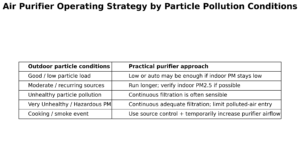
air-purifier-runtime-by-aqi-level.png
Figure 3. A practical operating strategy for particle pollution. AQI alone does not determine purifier size; room volume, infiltration and indoor sources also matter.
Is it safe to leave an air purifier on all day?
For a conventional fan-and-filter purifier designed for continuous household use, leaving it operating for long periods is normally consistent with how the product is intended to work, provided it is used according to the manufacturer’s instructions. Keep air intakes and outlets unobstructed, use the correct replacement filters and do not operate damaged equipment.
The important exception is technology that intentionally generates ozone. EPA advises against ozone generators sold as air cleaners for occupied spaces. Ozone is itself a respiratory irritant, and EPA reports that at concentrations that meet public-health standards it has little potential to remove many indoor contaminants.
Filter maintenance should also follow the product manual rather than a universal ‘clean every month’ rule. Some pre-filters are washable or vacuumable; many HEPA-type filters are not. Filter life varies with hours of operation, airflow, smoke, dust, pets and other pollution loads. Replace or maintain each filter as specified by its manufacturer and when performance indicators or operating conditions justify it.
Should I sleep with my air purifier on?
If the bedroom has particle pollution or allergens that the purifier can capture, running it overnight can be a practical choice because you spend many consecutive hours in the room. The key is to achieve useful clean-air delivery without creating so much noise or draft that sleep becomes uncomfortable.
Instead of buying a very small purifier and depending on its loud maximum setting, a somewhat larger, efficient unit may be able to deliver the required clean air at a quieter fan speed. Keep the intake and outlet clear and follow the manufacturer’s placement guidance. There is no universal requirement that the purifier must sit on a bedside table; many full-size models are designed for floor placement.
For people with asthma or allergies, filtration may reduce some airborne triggers, but an air purifier is not medical treatment and it does not eliminate all triggers. Bedding, moisture control, cleaning, smoke avoidance and other source-control measures can remain important.
Do air purifier settings make a difference when running it?
They do. Fan speed changes the amount of air moving through the filter, which changes the rate at which particles can be removed. EPA notes that higher fan speeds generally filter more air. The trade-off is usually more noise and often greater electricity consumption.
If you have only a short period to reduce particle levels before using a room, a higher fan speed can be useful. After concentrations fall, a lower speed may be enough to maintain them if the pollution load is modest. During severe smoke or PM2.5 episodes, the purifier may need to remain at a higher effective setting for much longer.
Automatic modes can be convenient, but remember that the purifier’s built-in sensor measures air near the unit. It may not represent the whole room, and different consumer sensors can respond differently. If air quality is especially important, an independent PM2.5 monitor placed away from the purifier outlet can provide a useful second check.
How much electricity does an air purifier use?
Small and medium air purifiers often use much less electricity than major heating or cooling equipment, but the cost varies too much by model, fan speed, electricity tariff and operating hours to give every household one fixed monthly dollar figure.
You can calculate it directly:
Monthly energy (kWh) = watts ÷ 1,000 × hours per day × days
For example, a 40-watt purifier running 24 hours a day for 30 days uses 28.8 kWh. A 70-watt unit under the same conditions uses 50.4 kWh. Multiply that figure by your local electricity price per kWh to estimate the monthly energy cost.
Energy efficiency should be compared with cleaning performance, not power consumption alone. ENERGY STAR’s current room-air-cleaner criteria use an Integrated Energy Factor related to CADR per watt and require reporting of particle CADR and operating power. A purifier that uses slightly more power but delivers substantially more clean air may be the better choice for a large room.
Also include replacement filters when comparing long-term cost. A low-priced purifier with expensive proprietary filters can cost more over several years than a more efficient unit with readily available replacement media.
How long does it take for an air purifier to clean a room?
There is no universal answer such as ‘a few hours.’ Cleaning time depends on the starting particle concentration, room volume, purifier CADR, fan speed, outdoor infiltration, indoor sources and how well air mixes through the room.
CADR is much more relevant than the purifier’s wattage. ENERGY STAR, for example, provides approximate minimum CADR guidance for particle removal based on room area and an 8-foot ceiling: about 65 CFM for 100 ft², 130 CFM for 200 ft², 195 CFM for 300 ft², 260 CFM for 400 ft², 325 CFM for 500 ft² and 390 CFM for 600 ft². Higher ceilings increase room volume and may justify higher CADR.
In a real room, particles are also being generated or entering while the purifier works. That is why a calculator should estimate the clean-air requirement from room volume and desired air-change rate rather than promise that every room becomes ‘fully clean’ after a fixed number of minutes.
| Room area* | ENERGY STAR minimum CADR | What it means |
| 100 ft² | 65 CFM | Particle-removal sizing reference |
| 200 ft² | 130 CFM | Particle-removal sizing reference |
| 300 ft² | 195 CFM | Particle-removal sizing reference |
| 400 ft² | 260 CFM | Particle-removal sizing reference |
| 500 ft² | 325 CFM | Particle-removal sizing reference |
| 600 ft² | 390 CFM | Particle-removal sizing reference |
*ENERGY STAR table assumes an 8-foot ceiling; higher ceilings may require greater CADR.
Should my air purifier be on the floor?
It depends on the purifier’s design. Many full-size room air cleaners are specifically designed to sit on the floor, while smaller models may be designed for a tabletop or wall mounting. Height by itself does not make a purifier clean the room faster.
The more important rules are to follow the manufacturer’s placement instructions, keep the intake and clean-air outlet unobstructed, and avoid curtains, furniture or tight corners that restrict airflow. ENERGY STAR likewise advises users to keep airflow clear and follow the product manual for optimum placement.
If you want to test two possible positions, use an independent PM2.5 monitor away from the purifier outlet and compare how quickly particle levels decline at the same fan setting under similar conditions. This is more informative than assuming that a bedside table or the floor is always superior.
Can I set a timer for my air purifier?
Yes. Many purifiers include timers, schedules or app controls. A timer can be useful when you know the room’s occupancy pattern or want the purifier to increase airflow before you arrive.
However, a timer should not become a substitute for adequate filtration. If outdoor PM2.5 remains high all day, switching the purifier off for a long scheduled period may allow indoor concentrations to rise again. In that situation, continuous operation at a lower practical speed may be more effective than repeatedly stopping and restarting.
Smart controls are most useful when combined with sensible room sizing and, ideally, measured indoor PM2.5. The future Air Quality Advisor on AirQualityIndex.org can use local AQI history, room volume and intended operating hours to suggest an operating range rather than one universal schedule.
What should you check before deciding to run an air purifier 24/7?
- Room size and ceiling height: a purifier must have enough clean-air delivery for the actual room volume.
- CADR at the pollutant of interest: smoke/PM2.5 CADR is especially relevant for fine-particle pollution.
- Fan speed you can tolerate: maximum CADR is less useful if the unit is too loud to run at that speed.
- Outdoor AQI and indoor sources: smoke, cooking, pets, cleaning and open windows can change the pollution load.
- Filter condition and replacement cost: loaded filters and expensive consumables affect practical performance and ownership cost.
- Energy efficiency: compare clean-air delivery with watts, not watts alone.
- Ozone information: avoid intentional ozone generation in occupied spaces.
Conclusion
Running an air cleaner for a few hours does not guarantee clean air for the rest of the day because airborne particles do not stop entering or being generated when the purifier switches off. For many households, particularly during high-PM2.5 days, smoke events or periods with persistent indoor particle sources, long or continuous operation at an appropriate fan speed is the most practical approach.
But the better question is not simply ‘Should I run it 24 hours?’ It is: ‘Is this purifier delivering enough clean air for my room and pollution level at the speed I actually use?’ CADR, room volume, ACH, outdoor AQI, indoor sources, noise, energy use and filter condition all help answer that question.
Check your local AQI before deciding how aggressively to operate filtration, especially during smoke or urban pollution episodes. When AirQualityIndex.org’s Air Quality Advisor is available, it can combine your location and historical AQI exposure with room dimensions and usage to estimate the clean-air specification you need. Until then, choose a correctly sized purifier, keep airflow unobstructed, maintain its filters and use it consistently when particle pollution is present.
Explore more
AQI Calculator; Air Quality Explained; Air Purifiers related
Authoritative references
- U.S. EPA — Guide to Air Cleaners in the Home — https://www.epa.gov/indoor-air-quality-iaq/guide-air-cleaners-home
- ENERGY STAR — Air Cleaners — https://www.energystar.gov/products/air_cleaners
- ENERGY STAR — Room Air Cleaners Key Product Criteria — https://www.energystar.gov/products/air_purifiers_cleaners/key_product_criteria
- U.S. EPA — Ozone Generators that are Sold as Air Cleaners — https://www.epa.gov/indoor-air-quality-iaq/ozone-generators-are-sold-air-cleaners


Trackbacks/Pingbacks