
Compare moisture removal, temperature suitability and lifetime running costs.
Compressor and desiccant dehumidifiers remove moisture by different physical processes. Neither technology is universally superior: ambient temperature, humidity, extraction rate, electricity use, noise, drainage and maintenance determine which is more suitable. This is a technology comparison, not a hands-on ranking of individual models.
Quick answer
Compare moisture removal, temperature suitability and lifetime running costs. Start with the measurements and published ratings described below; avoid treating illustrative numbers as guarantees of installed performance.
How compressor dehumidifiers remove water
A refrigerant system cools a coil below the incoming air’s dew point, causing water to condense. The machine collects or drains this water and returns warmer, drier air. Compressor units can be effective in warm, humid spaces, but performance commonly declines as air becomes colder and defrosting may interrupt extraction.
Look for the exact model’s rated operating-temperature range and extraction at relevant test conditions. Do not assume the advertised maximum pints/day applies to an unheated winter garage.
How desiccant machines remove water
A desiccant rotor or other sorbent material captures water vapour; a regeneration process releases the moisture for collection or exhaust, depending on design. Because operation does not depend on a cold evaporator in the same way, some desiccant designs suit lower-temperature conditions.
Regeneration uses energy and often adds heat. Some desiccant products are industrial or ducted systems, so distinguish portable domestic models from commercial equipment rather than treating all desiccant units as interchangeable.
Comparison at a glance
| Criterion | Compressor | Desiccant |
| Warm humid room | Often efficient | Compare power and output |
| Cold unheated room | Check defrost and ratings | May suit some models |
| Heat added | Some | Often more regeneration heat |
| Running cost | Compare measured L/kWh | Compare measured L/kWh |
| Drainage | Model-specific | Model-specific |
Temperature is a decisive variable
A heated laundry room at 23°C and an unheated cellar at 8°C may have the same relative humidity but very different absolute moisture contents and compressor performance. At low temperature, examine both low-temperature compressor options and desiccant options.
For a warm living room, compare energy factor and actual removal rates. For a cold area, focus on sustained removal at the expected temperature, defrost behaviour, safety and drainage.
Compare electricity fairly
Energy (kWh) = average power (kW) × running hours (h). A 300 W machine used for eight hours consumes 2.4 kWh; a 600 W machine used for four hours also consumes 2.4 kWh. These scenarios have equal electricity consumption but may remove different amounts of water.
At an illustrative $0.20/kWh both cost $0.48. To compare cost per litre, you need comparable water-removal measurements at the same temperature and RH. Do not use nameplate watts alone as a proxy for efficiency.
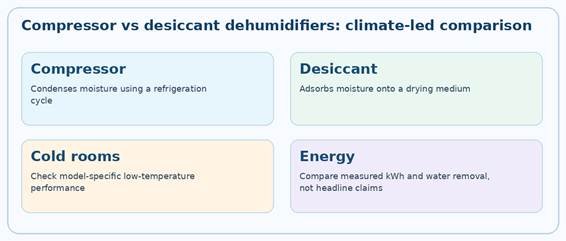
Figure: Original editorial decision illustration; conceptual guidance, not independent laboratory test results.
Noise, maintenance and drainage
Compressor machines include a refrigeration system and fan; desiccant machines have fans and regeneration mechanisms. Acoustic performance depends on the exact model and operating mode. A low published dB figure at a quiet setting may coincide with reduced water removal.
Check whether a continuous drain is available, whether the machine can restart safely after a power interruption, how filters are accessed and whether local service support exists. Keep airflow paths clear and follow the installation manual.
Decision scenarios
Warm coastal apartment: shortlist efficient compressor models with good humidity control. Cold utility room: compare tested low-temperature compressor and desiccant models. Intermittent laundry drying: compare extraction rate, drainage and operating cost. Seasonal property: check restart behaviour and safe unattended use.
Before purchasing, record temperature and RH over several days. Fix leaks and moisture sources. A machine that suits the climate still cannot correct persistent structural water intrusion.
A practical decision checklist
• Record the actual room temperature, relative humidity and the operating schedule before choosing equipment.
• Compare the same units and test conditions; do not mix marketing maximums with independent rated performance.
• Confirm maintenance access, electrical compatibility, local warranty, replacement parts and safe installation.
• Recheck results after installation using measurements, not only the calculated or advertised output.
Common questions
Does a larger capacity always mean a better purchase?
No. Controllability, actual operating conditions, noise, energy consumption and maintenance can matter more than a headline maximum.
Can a calculator guarantee real-world performance?
No. It provides a transparent preliminary estimate or published selection band. Actual delivery depends on the installed equipment and site conditions.
Can outdoor AQI alone determine this equipment choice?
No. AQI does not describe room moisture, airflow, duct losses or the complete indoor environment.
What should I verify before ordering?
The exact model number, published rating method, local power and safety requirements, delivery, return terms and warranty.
Use the Air Quality Advisor
For a transparent preliminary calculation, use the Air Quality Advisor. Confirm actual product specifications, test conditions and local installation requirements before purchase.
References and further reading
Affiliate disclosure
Some shopping links on AirQualityIndex.org may earn a commission at no additional cost to the visitor. Technical guidance and product suitability should not depend on commission rates.