A good air purifier can substantially reduce airborne particles in a room—but only when the filtration technology, CADR, room size, placement and operating conditions are appropriate for the problem being addressed. This guide explains what air purifiers can and cannot remove, how HEPA filtration and CADR relate to real-world performance, why room volume and runtime matter, and how to decide whether portable filtration should form part of a broader strategy involving source control, ventilation and outdoor AQI conditions.
Yes—but only when the purifier matches the pollution problem
A portable air purifier can improve indoor air quality by reducing airborne pollutants that its filtration system is designed to capture. For particles such as PM2.5, smoke, pollen and some airborne dust, a well-sized high-efficiency purifier can be very effective. But “air purifier” is not a universal solution. A particle filter will not repair a mold leak, stop a gas stove from emitting combustion pollutants or automatically remove every volatile organic compound.
The useful question is therefore not “Do air purifiers work?” but “What pollutant am I trying to control, how much clean air does this unit actually deliver, and is filtration the right intervention for this room?”
Key takeaways
- For particles, clean-air delivery (CADR) and room size matter as much as the filter label.
- HEPA/high-efficiency particle filtration can reduce PM2.5, smoke, pollen and other airborne particles.
- Gases and odors require gas-phase media such as substantial activated carbon; particle CADR does not rate gas removal.
- Placement, fan speed, runtime and filter condition strongly affect real-world performance.
- Source control and appropriate ventilation remain fundamental parts of indoor-air management.
- Avoid technologies that intentionally generate ozone in occupied spaces.
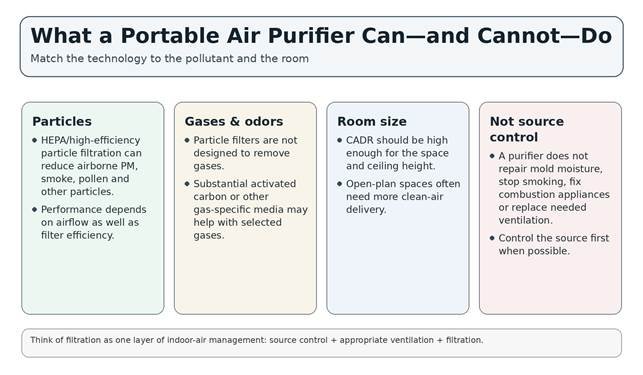
Figure: What portable air purifiers can and cannot do for particles, gases and source control.
What does “improve air quality” actually mean?
Indoor air quality includes particles, gases, biological material, humidity, temperature and ventilation. A purifier can improve one part of that picture without solving the rest. For example, a HEPA purifier may sharply reduce airborne smoke particles while carbon dioxide still rises in an occupied closed room because the purifier does not provide outdoor air.
Similarly, filtration may reduce airborne mold spores but cannot dry a wet wall or stop mold growth. EPA’s approach to indoor air emphasizes source control, ventilation and filtration as complementary strategies. The best intervention depends on the dominant source and pollutant.
HEPA filters and particle removal
HEPA is a high-efficiency particle-filtration standard. In a portable air cleaner, however, filter efficiency alone does not tell you how quickly the room air will be cleaned. Air must actually pass through the filter, which is why airflow and CADR are essential. A small purifier with an excellent filter can underperform in a large room simply because it processes too little air.
For PM2.5, smoke and other fine particles, look for credible particle performance data. EPA notes that portable air cleaners often achieve high CADR using HEPA filters, but other technologies can also produce useful clean-air delivery.
CADR: the number that connects filtration to room size
Clean Air Delivery Rate measures the volume of contaminant-free air delivered by a room air cleaner for a specified particle category. Higher CADR means more clean air per unit time. ENERGY STAR’s current reference table gives approximate minimum particle CADRs of 65, 130, 195, 260, 325 and 390 cfm for rooms of 100, 200, 300, 400, 500 and 600 square feet respectively, assuming an eight-foot ceiling.
Those values are useful starting points, not universal guarantees. High ceilings increase room volume. Open doors connect spaces. Heavy smoke may justify more clean-air delivery. Noise can force users to operate a purifier below its maximum rated speed. The best sizing decision considers how the device will actually be used.
A second way to think: air changes per hour
Air changes per hour (ACH) describes how many room-volumes of clean air are delivered per hour. For a purifier rated in cubic feet per minute, an approximate clean-air ACH can be calculated as: ACH = CADR × 60 ÷ room volume.
Consider a 20 ft × 20 ft room with a 9 ft ceiling. Volume is 3,600 cubic feet. A purifier delivering 300 cfm of clean air provides about 5 clean-air changes per hour: 300 × 60 ÷ 3,600 = 5. This calculation is useful because it automatically accounts for ceiling height.
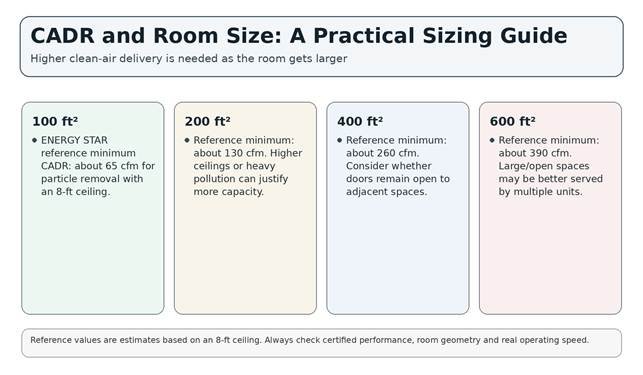
Figure: CADR and room-size reference guide for portable air cleaners.
What about gases, VOCs and odors?
HEPA filters are designed for particles, not gases. To reduce selected gases or odors, a purifier needs gas-phase media such as activated carbon or another sorbent designed for the target compounds. EPA notes that activated carbon can be effective when a substantial amount of material is used. Thin carbon sheets may have limited capacity.
There is also no simple, widely used consumer performance rating equivalent to particle CADR for all gas removal. That makes gas claims harder to compare. Source removal and ventilation are often more important for VOCs and combustion gases than relying on a small purifier.
Where should you place an air purifier?
Put the purifier where it can move air freely and where people spend time. Do not block the intake or clean-air outlet with curtains, furniture or walls unless the manufacturer specifically designs the unit for that placement. EPA technical guidance recommends locating portable cleaners so clean air reaches occupants without obstruction.
A bedroom is often a logical location because of the hours spent there. During wildfire smoke, a designated cleaner-air room may be more effective than trying to clean an entire poorly sealed home with one small device. For open-plan spaces, calculate the whole connected volume or consider multiple units.
Fan speed and runtime are part of performance
Purifiers are often tested at a high fan setting, while households may run them on a quiet low setting. That matters because lower airflow usually means lower clean-air delivery. EPA notes that higher fan speeds and longer run times generally increase the amount of air filtered.
During persistent PM2.5, smoke or allergy episodes, longer operation can maintain lower particle concentrations than occasional short bursts. The practical setting is the highest speed occupants can comfortably tolerate, especially during periods when particle sources are active.
Filter maintenance and real-world decline
Filters accumulate material. A heavily loaded filter can increase resistance and reduce airflow, and gas-phase media eventually becomes saturated. Replacement intervals therefore depend on pollution load, operating hours, filter area and device design rather than a universal calendar rule.
During wildfire smoke or severe dust, inspect filters more frequently. Follow the manufacturer’s instructions, but do not assume an electronic filter-life indicator directly measures remaining filtration capacity; many are based partly or entirely on operating time.
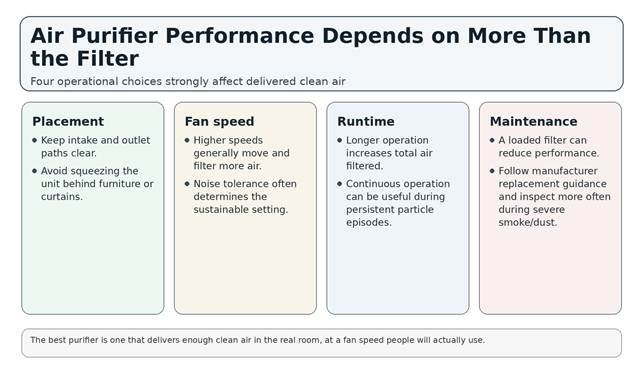
Figure: How placement, fan speed, runtime and maintenance affect air purifier performance.
Can a purifier help with outdoor pollution that gets indoors?
Yes, particularly for particles. Outdoor PM2.5 can infiltrate buildings through leakage, doors, windows and ventilation. When outdoor air is poor, closing openings and filtering recirculated indoor air can reduce particle exposure. When outdoor air improves, appropriate ventilation may again be beneficial for indoor-generated pollutants.
This makes local AQI relevant to purifier operation. A high outdoor PM2.5 episode may justify more filtration and less uncontrolled ventilation, while a clean-air period may be an opportunity to ventilate. The correct strategy depends on the pollutant, weather, indoor sources and building.
What an air purifier cannot fix
A purifier cannot repair a moisture problem causing mold. It cannot make smoking indoors safe. It cannot replace a functioning kitchen exhaust system. It does not supply oxygen or remove carbon dioxide simply by recirculating room air. A particle purifier does not automatically remove carbon monoxide or all VOCs.
These limitations are important because product marketing can encourage people to treat filtration as a substitute for fixing the source. Source control usually comes first: remove or reduce the pollutant source when feasible, ventilate appropriately, then use filtration to reduce remaining airborne contamination.
Ozone-generating devices and safety
Ozone is a lung irritant and should not be intentionally generated in occupied spaces as an air-cleaning strategy. Some technologies may also produce ozone or other by-products under certain conditions. EPA advises against ozone generators sold as air cleaners for occupied spaces.
Consumers should look beyond labels such as “ion,” “plasma,” “active oxygen” or other marketing terms and ask what is emitted, what independent testing exists, and whether the device is certified under applicable low-ozone requirements.
How to choose a purifier without starting from a brand
A specification-first approach is more reliable than beginning with a brand list. Identify the pollutant: particles, gases or both. Measure the room and ceiling height. Decide how much clean-air delivery is needed. Check noise at the fan speed you expect to use, filter replacement cost, energy consumption and whether the intake/outlet arrangement suits the room.
This is the logic AirQualityIndex.org will use in its planned Air Quality Advisor: location and pollution context first, required specification second, and only then matching products. A product should not rank highly simply because it is popular or sponsored.
Noise, energy and the “usable CADR” problem
A purifier that is powerful only at an intolerably loud setting may deliver much less clean air in daily use. Compare noise and power consumption at several fan speeds where data are available. Two quieter medium-size units can sometimes provide more practical coverage than one large unit that occupants continually turn down, although cost, maintenance and room layout also matter.
Multiple rooms and open-plan homes
Portable cleaners primarily clean the air that reaches them. Closed bedrooms behave differently from a connected living-kitchen-dining area. Do not size one unit for a bedroom and expect the same performance across an entire floor. For several occupied rooms, use multiple appropriately sized units or evaluate whole-home HVAC filtration. Door position and air mixing can materially change results.
How to verify whether filtration is helping
If you have a reasonably reliable PM2.5 monitor, a simple before-and-after experiment can be informative. Avoid creating particles, note the starting concentration, run the purifier at a known speed, and watch the decay over time. Repeat under similar conditions. This is not a laboratory CADR test, but it can reveal blocked airflow, an undersized unit or a strong ongoing source. Do not compare readings across different sensors as if they were perfectly calibrated instruments.
Cost of ownership matters
Purchase price is only part of the decision. Replacement filters, electricity, availability of genuine filters and expected service life can dominate long-term cost. A specification-first shortlist should therefore compare annualized filter cost and realistic operating power as well as CADR. Very cheap devices with proprietary, frequently replaced filters can become expensive to run continuously.
Purifier performance during cooking, dust and smoke peaks
A purifier does not encounter a constant pollution load. Cooking can create a sharp indoor particle peak; cleaning can resuspend dust; an open door during a wildfire event can admit a burst of smoke. A unit sized only for a low background concentration may take a long time to recover from these peaks. Source control is therefore the first response where possible: use an effective range hood while cooking, avoid smoking indoors and keep smoke entry low. Filtration then removes the residual airborne particles.
This also explains why a real-time PM monitor can be educational. If a cooking event sends PM sharply upward and the concentration falls faster when the purifier is running, the household can see both the source and the value of filtration. The lesson should not be that the purifier makes pollution harmless; it is that source control and filtration work together.
A simple specification-first buying checklist
Before comparing brands, write down five numbers or requirements: room floor area, ceiling height, target pollutant, minimum clean-air delivery and acceptable noise. Then add filter replacement cost and power consumption. For particles, prefer independently verified CADR data. For gases, look for meaningful sorbent media and credible testing rather than assuming a carbon-coloured sheet is sufficient. Confirm that replacement filters are available in your country. Finally, reject any product whose main selling point is intentionally generating ozone in an occupied room. This short checklist prevents attractive marketing features from displacing the engineering variables that actually determine useful performance.
Should you oversize an air purifier?
Moderate oversizing can be useful because it allows a target clean-air delivery at a quieter fan speed and provides headroom for higher ceilings or pollution episodes. But extreme oversizing can waste money, floor space and energy. The better approach is to calculate the room volume and desired clean-air delivery, then select a device that can meet that target without requiring maximum speed all the time.
For bedrooms, noise at the intended night setting is especially important. For wildfire-prone areas, extra capacity can be valuable because filters may load more quickly and outdoor concentrations can become very high. For ordinary pollen control in a small room, the same degree of oversizing may be unnecessary.
Conclusion
Air purifiers can materially improve indoor particle air quality when they are correctly sized, well placed, operated long enough and maintained. Their limits are just as important: they do not solve every gas, source or ventilation problem.
For a better decision, combine current outdoor AQI with the pollutant you are trying to control, room volume, CADR, realistic fan speed and source control. Next on AirQualityIndex.org: read PM2.5 Explained, How Outdoor Air Pollution Gets Inside Your Home, and the detailed Air Purifier guides for sizing, runtime, placement and filter replacement.
Suggested internal links
- Air Quality Near Me
- PM2.5 Explained
- Does Outdoor Air Pollution Affect Indoor Air Quality?
- Air Quality Data & Methodology