
Compare local extraction, balanced fresh air and heat or moisture recovery.
An exhaust fan, heat-recovery ventilator (HRV) and energy-recovery ventilator (ERV) can all be useful, but they do different jobs. A bathroom fan removes moisture near its source. Balanced systems exchange outdoor and indoor air while transferring some thermal energy, and in the case of many ERVs, some moisture. A sensible choice begins with the ventilation problem rather than the equipment acronym.
Quick answer
Compare local extraction, balanced fresh air and heat or moisture recovery. Start with the measurements and published ratings described below; avoid treating illustrative numbers as guarantees of installed performance.
Exhaust-only systems
Exhaust fans remove air from kitchens, bathrooms or other source areas. Replacement air must enter elsewhere, through planned openings or unintended leaks. Simple exhaust can be cost-effective for localized moisture, but pressure effects and uncontrolled make-up air matter.
Do not route kitchen grease exhaust through a general HRV or ERV unless a system is specifically designed and approved for it. Combustion appliances and backdraft risks require particular care.
HRV: sensible heat recovery
An HRV transfers heat between outgoing and incoming air streams while keeping the air paths substantially separated. It can reduce heating or cooling energy penalties associated with ventilation compared with simple exhaust and supply, depending on climate and operation.
HRVs still need appropriate airflow, filtration, condensate management and maintenance. The recovery efficiency advertised under one test condition does not describe every installed operating point.
Comparison at a glance
| Criterion | Exhaust fan | HRV | ERV |
| Typical purpose | Local removal | Balanced air + heat | Balanced air + heat/moisture |
| Supply air | Via make-up paths | Mechanical | Mechanical |
| Energy recovery | No | Sensible heat | Heat + some moisture |
| Design complexity | Lower | Higher | Higher |
ERV: heat and moisture transfer
Many ERVs transfer both sensible heat and some water vapour across an exchange medium. This can help manage latent loads in some climates, but it is not a dehumidifier and does not replace source control or appropriate cooling/dehumidification.
Performance depends on climate, core design and control strategy. In hot-humid conditions, moisture recovery may reduce the ventilation-related humidity burden; in other situations the desired direction of moisture transfer differs.
Airflow and code compliance
For illustration, a 100 m² home with a 2.5 m ceiling contains 250 m³ of air. An assumed 0.35 ACH corresponds to 87.5 m³/h, about 51.5 CFM. This is an arithmetic example, not a universal residential code requirement.
Actual whole-home ventilation rates depend on applicable standards, occupancy, dwelling characteristics and system configuration. Consult local codes and a qualified designer for a compliance decision.
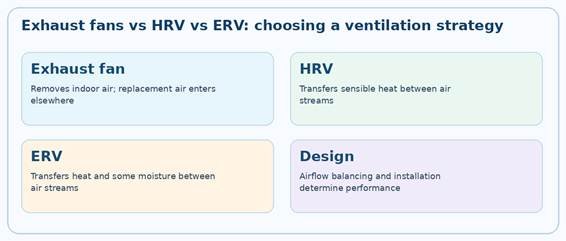
Figure: Original editorial decision illustration; conceptual guidance, not independent laboratory test results.
Pollution, filtration and pressure
Outdoor air may contain fine particles, smoke or pollen. Balanced ventilation can incorporate suitable filtration, but filter pressure drop must be reflected in equipment selection. Exhaust-only systems may draw replacement air through poorly controlled openings.
Air purification is not equivalent to fresh-air ventilation. Where outdoor AQI is poor, consider filtration and control strategy without compromising essential safe ventilation.
Lifecycle and maintenance
Compare installed cost, ductwork, electrical demand, filter changes, access to cores, condensate handling, sound and commissioning. An inexpensive fan can be appropriate for a bathroom; a more complex balanced system may justify its cost when continuous whole-house exchange and heat recovery are priorities.
Before choosing, document what the system must achieve, how airflow will be measured, who will maintain it and what happens when filters become dirty or outdoor conditions change.
A practical decision checklist
• Record the actual room temperature, relative humidity and the operating schedule before choosing equipment.
• Compare the same units and test conditions; do not mix marketing maximums with independent rated performance.
• Confirm maintenance access, electrical compatibility, local warranty, replacement parts and safe installation.
• Recheck results after installation using measurements, not only the calculated or advertised output.
Common questions
Does a larger capacity always mean a better purchase?
No. Controllability, actual operating conditions, noise, energy consumption and maintenance can matter more than a headline maximum.
Can a calculator guarantee real-world performance?
No. It provides a transparent preliminary estimate or published selection band. Actual delivery depends on the installed equipment and site conditions.
Can outdoor AQI alone determine this equipment choice?
No. AQI does not describe room moisture, airflow, duct losses or the complete indoor environment.
What should I verify before ordering?
The exact model number, published rating method, local power and safety requirements, delivery, return terms and warranty.
Use the Air Quality Advisor
For a transparent preliminary calculation, use the Air Quality Advisor. Confirm actual product specifications, test conditions and local installation requirements before purchase.
References and further reading
Affiliate disclosure
Some shopping links on AirQualityIndex.org may earn a commission at no additional cost to the visitor. Technical guidance and product suitability should not depend on commission rates.