
A transparent guide to selecting capacity bands without inventing precision.
A dehumidifier is rated by the volume of water it removes under specified test conditions, not by the volume of its collection tank. Room area matters, but a damp basement and a well-sealed bedroom of equal size can impose very different moisture loads. A trustworthy selection process therefore starts with dampness and water sources, then uses the published capacity guidance as a shopping band rather than an exact promise.
Quick answer
A transparent guide to selecting capacity bands without inventing precision. Start with the measurements and published ratings described below; avoid treating illustrative numbers as guarantees of installed performance.
What the official sizing table says
ENERGY STAR groups portable dehumidifiers into two area classes: below 2,000 ft² and above 2,000 ft². For the smaller class, slightly to moderately damp spaces are assigned 20–30 US pints/day; very damp spaces 25–40; and wet spaces 30–50. For the larger class, the guidance gives 30+, 40+ and 50+ respectively. These are purchasing bands, not a moisture balance calculated from floor area.
If a room is 155 m², the conversion is 155 × 10.7639 = about 1,668 ft². In moderately damp conditions, that maps to 20–30 US pints/day, approximately 9.5–14.2 L/day. An increase from 155 to 160 m² does not necessarily change the published band. A user should see why, rather than an artificial decimal interpolation.
How to measure the problem
Use a hygrometer over several days, preferably morning and evening. Note the highest readings after showers, cooking or laundry, as well as any persistent musty smell, surface condensation or damp patches. Humidity readings change with temperature, so record both. Check gutters, plumbing, walls and drainage before assuming a larger appliance will solve the issue.
Water intrusion and wet building materials may need remediation; a dehumidifier can support drying but cannot substitute for repairing leaks. EPA advises controlling sources of moisture and keeping indoor relative humidity below 60%, ideally 30–50%.
Comparison at a glance
| Condition | Below 2,000 ft² | Above 2,000 ft² |
| Slightly/moderately damp | 20–30 US pints/day | 30+ |
| Very damp | 25–40 US pints/day | 40+ |
| Wet | 30–50 US pints/day | 50+ |
Capacity is not the same as efficiency
A 30-pint rating means removal under a defined laboratory test condition. It does not mean the appliance will remove exactly 30 pints every day in your house. Capacity depends on ambient temperature and relative humidity. Integrated Energy Factor, in L/kWh, measures removal efficiency under the applicable test method; compare products rated under compatible standards.
ENERGY STAR explains that the US test procedure changed, so older and newer headline pint ratings are not directly interchangeable. When replacing a machine, confirm the rating year and method before concluding that a modern lower-numbered model is weaker.
A realistic purchase decision
Consider a warm, frequently used laundry area and a cooler basement, both measuring 155 m². The laundry may have strong intermittent moisture input and require reliable drainage. The basement may suffer cold-coil performance losses and need a model rated for lower temperatures. Identical floor areas do not justify identical product choices.
Look for continuous drainage, bucket-full shutoff, humidistat accuracy, noise, accessible filter maintenance, warranty, locally compatible power supply and a rated operating-temperature range. For persistent high humidity, monitor actual RH after installation and reassess the moisture source.
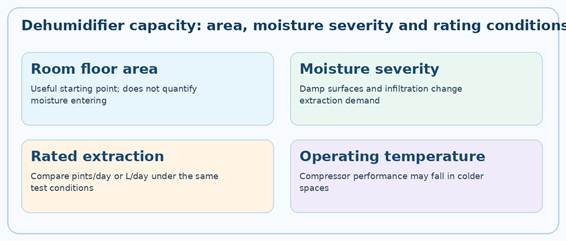
Figure: Original editorial decision illustration; conceptual guidance, not independent laboratory test results.
Worked running-cost example
If a dehumidifier averages 350 W for 8 hours daily, consumption is 0.350 kW × 8 h = 2.8 kWh/day. At an illustrative tariff of $0.20/kWh, electricity cost is $0.56/day. Actual running hours depend on humidistat setting, outdoor conditions and moisture generation.
For a fair comparison, do not simply compare nameplate watts. A higher-power model that removes water faster may run fewer hours. If comparable test data are available, use energy per litre of water removed and the expected duty cycle.
Choosing an appropriate range
Start with the published band; then examine the room’s measured temperature, drainage options and moisture sources. If the space is larger than 2,000 ft² or has unusually high loads, consider professional assessment or multiple appliances. Avoid presenting an arbitrary midpoint as a laboratory-derived optimum.
A useful advisor can still be interactive: changing area may move the selection between published classes, while changing dampness moves between bands. Every unchanged result should be explained openly rather than concealed behind a false precision formula.
A practical decision checklist
• Record the actual room temperature, relative humidity and the operating schedule before choosing equipment.
• Compare the same units and test conditions; do not mix marketing maximums with independent rated performance.
• Confirm maintenance access, electrical compatibility, local warranty, replacement parts and safe installation.
• Recheck results after installation using measurements, not only the calculated or advertised output.
Common questions
Does a larger capacity always mean a better purchase?
No. Controllability, actual operating conditions, noise, energy consumption and maintenance can matter more than a headline maximum.
Can a calculator guarantee real-world performance?
No. It provides a transparent preliminary estimate or published selection band. Actual delivery depends on the installed equipment and site conditions.
Can outdoor AQI alone determine this equipment choice?
No. AQI does not describe room moisture, airflow, duct losses or the complete indoor environment.
What should I verify before ordering?
The exact model number, published rating method, local power and safety requirements, delivery, return terms and warranty.
Use the Air Quality Advisor
For a transparent preliminary calculation, use the Air Quality Advisor. Confirm actual product specifications, test conditions and local installation requirements before purchase.
References and further reading
Affiliate disclosure
Some shopping links on AirQualityIndex.org may earn a commission at no additional cost to the visitor. Technical guidance and product suitability should not depend on commission rates.