
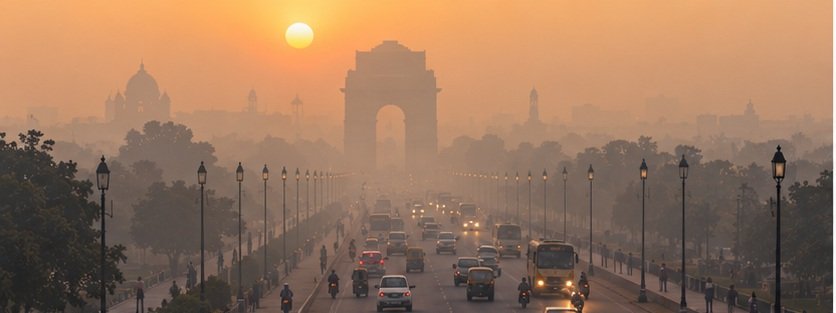
Every winter, Delhi and the surrounding National Capital Region experience some of the world’s most severe episodes of air pollution. Fine particle pollution can rise dramatically as emissions from traffic, industry, construction, household fuel use, waste burning and seasonal agricultural fires combine with cold, calm weather that traps pollution close to the ground. But Delhi’s winter smog is more complicated than any single source. This article explains why pollution becomes so severe, what happens to PM2.5 during winter, how pollution travels across the wider Indo-Gangetic Plain, what it means for health, and which measures can make a lasting difference.
Delhi’s winter pollution is an airshed problem, not a single-source problem
Delhi’s most severe pollution episodes usually occur when a large emissions burden meets meteorological conditions that prevent pollutants from dispersing. Road transport, industry, power and fuel combustion, construction and road dust, household and commercial combustion, waste burning and seasonal agricultural fires can all contribute. Their relative importance changes by place, season and episode.
That is why a useful explanation must separate two questions: what is emitted, and what the atmosphere does with those emissions. Winter often makes the second part much less forgiving. The wider Indo-Gangetic Plain behaves as a connected airshed, so pollution produced outside Delhi can be transported into the National Capital Region, while Delhi’s own emissions also contribute to the regional burden.
Why winter weather traps pollution
Cold-season nights favour a shallow atmospheric boundary layer. Near the surface, cooling can produce stable conditions and temperature inversions in which warmer air overlies cooler air. Vertical mixing weakens, wind speeds are often low, and the same quantity of emissions becomes concentrated in a much smaller volume of air.
The effect can be especially strong overnight and during early morning hours. Once sunlight warms the surface and winds strengthen, the mixing layer may deepen and concentrations can fall. This is one reason a city’s PM2.5 and AQI can change substantially over a single day even without an equally dramatic change in emissions.
PM2.5 is not only emitted directly
A significant part of Delhi’s fine-particle pollution can form after gases are released into the atmosphere. Gases from traffic, industry, agriculture and fuel burning can react with other substances and become new tiny particles. Scientists call this “secondary particle formation.” Cool and humid winter weather can help these particles grow and accumulate.
This matters for policy. Controlling only visible dust or smoke cannot solve a PM2.5 problem if a substantial fraction is being formed chemically in the atmosphere from pollution gases that can later form particles.
Humidity can make Delhi’s particle problem look different
A 2025 study led by researchers at the University of Birmingham reported that water absorption by airborne particles—the uptake of atmospheric water by particles—can cause fine particles in New Delhi to swell and can bias some sampling measurements. The researchers estimated that particulate concentrations could be underestimated by up to about 20% under certain conditions, with the greatest bias during humid winter morning rush hours.
The finding is important for two reasons. First, it shows that particle chemistry and humidity affect not only exposure but also measurement. Second, it reinforces why observation time, method and meteorology should accompany any interpretation of an AQI number.
Crop-residue burning matters, but it is not the whole explanation
Post-monsoon agricultural burning in parts of Punjab and Haryana can make a major episodic contribution when winds transport smoke toward Delhi. But attributing Delhi’s entire winter pollution crisis to stubble burning is scientifically inadequate. Traffic, industry, dust, waste and biomass burning, energy use and formation of new fine particles in the air continue after the burning season subsides.
The practical conclusion is that Delhi needs both local emissions control and regional airshed cooperation. Measures in only one city—or only one sector—cannot fully address a pollution system that operates across state boundaries.
Health implications
WHO’s global air-quality guidelines reflect a large evidence base linking particulate pollution with cardiovascular and respiratory disease and other adverse outcomes. Short periods of very high PM2.5 can aggravate asthma and other respiratory conditions; long-term exposure contributes to a much larger chronic health burden.
Children, older adults, pregnant people, outdoor workers and people with existing heart or lung disease may be more susceptible during severe episodes. AQI should therefore be used as a practical exposure-management tool, not simply as a city ranking.
What residents can do during severe episodes
Check current conditions and the observation time rather than assuming every winter day is equally polluted. When particle pollution is high, reducing prolonged strenuous outdoor activity can lower inhaled dose. Indoors, source control and appropriately sized particle filtration can reduce exposure; ventilation decisions should take outdoor air quality into account.
Well-fitted particulate respirators can reduce inhalation of particles when outdoor exposure cannot be avoided, but they do not remove gaseous pollutants and their effectiveness depends on fit and use. People with medical conditions should follow advice from their healthcare professionals.
What Delhi needs long term
The durable solution is not a single emergency restriction. It is sustained control of transport and industrial emissions, cleaner fuels and energy, dust management, waste-burning prevention, agricultural alternatives, monitoring, enforcement and coordinated airshed management across the Indo-Gangetic Plain.
Explore Air Quality Related Resources
Delhi live AQI · India air-quality · PM2.5 Explained · AQI Explained · AQI Near Me · Data & Methodology
References
World Health Organization — WHO Global Air Quality Guidelines (2021) — https://www.who.int/publications/i/item/9789240034228
University of Birmingham / ScienceDaily — Delhi air pollution worse than expected as water vapor skews figures (2025) — https://www.sciencedaily.com/releases/2025/03/250312124618.htm
World Bank — Air Quality Management in the Indo-Gangetic Plains and Himalayan Foothills — https://www.worldbank.org/en/brief/2025/12/09/air-quality-management-in-the-indo-gangetic-plains-and-himalayan-foothills