
How air pollution, particulate matter and major gaseous pollutants can affect health — and how to interpret AQI information responsibly.
Last reviewed: October 2026
Why air quality matters for health
Air pollution is not only an environmental indicator; it is an important determinant of human health. Outdoor air can contain particulate matter and gases produced by transport, power generation, industry, household fuel combustion, construction, fires, dust and atmospheric chemical reactions. Exposure may be short-term during a pollution episode or repeated over months and years. Both patterns matter.
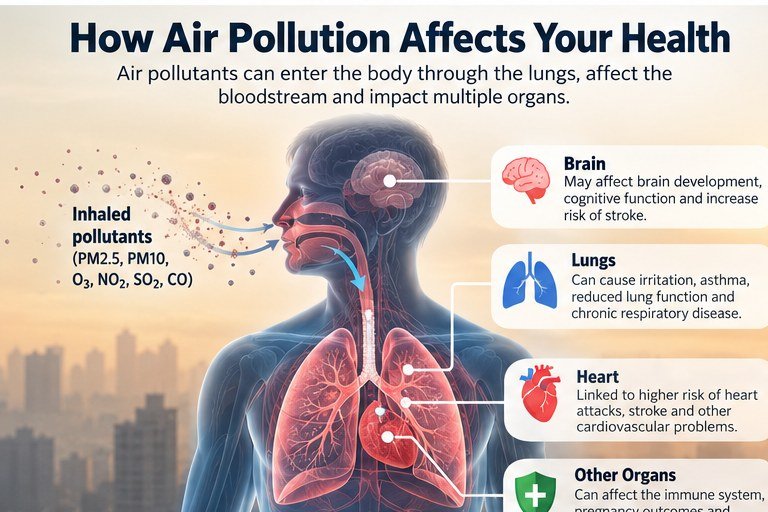
The World Health Organization (WHO) identifies particulate matter (PM₂.₅ and PM₁₀), ozone (O₃), nitrogen dioxide (NO₂), sulfur dioxide (SO₂) and carbon monoxide (CO) among pollutants with well-established health importance. Air-quality information is therefore most useful when the headline AQI is read together with the underlying pollutant, source, units, averaging period and update time.
Why air pollution affects more than the lungs
Fine particulate matter is especially important. PM₂.₅ consists of particles with an aerodynamic diameter of 2.5 micrometres or less. These particles can penetrate deeply into the respiratory tract; evidence reviewed by WHO and the U.S. EPA links fine-particle exposure with respiratory and cardiovascular effects. WHO also recognizes air pollution as a risk factor for major noncommunicable diseases including ischaemic heart disease, stroke, chronic obstructive pulmonary disease, asthma and cancer.
Major pollutants and health significance
PM₂.₅
Fine particles can reach deep into the lungs. Short- and long-term exposure has been associated with cardiovascular and respiratory effects. PM₂.₅ may be emitted directly or form secondarily in the atmosphere.
PM₁₀
Inhalable particles up to 10 µm include the PM₂.₅ fraction plus larger particles. Sources can include dust, construction, industry, agriculture and combustion.
Ozone (O₃)
Ground-level ozone is a secondary pollutant formed through photochemical reactions. Elevated exposure can irritate airways, aggravate asthma and reduce lung function.
Nitrogen dioxide (NO₂)
NO₂ is associated with combustion sources such as traffic, heating, power generation and industry. It can irritate airways and also participates in ozone and secondary-particle formation.
Sulfur dioxide (SO₂)
SO₂ is associated particularly with sulfur-containing fuels and some industrial processes. It can affect the respiratory system and contributes to formation of sulfate particles.
Carbon monoxide (CO)
CO is produced by incomplete combustion. It interferes with the blood's ability to transport oxygen and can be acutely dangerous at high concentrations, especially indoors.
WHO health-based air-quality guideline levels
WHO's 2021 Global Air Quality Guidelines provide evidence-based reference levels intended to support protection of public health. They are not universal legal limits, and national standards may differ.
| Pollutant | Averaging period | WHO 2021 AQG |
|---|---|---|
| PM₂.₅ | Annual | 5 µg/m³ |
| PM₂.₅ | 24-hour | 15 µg/m³ |
| PM₁₀ | Annual | 15 µg/m³ |
| PM₁₀ | 24-hour | 45 µg/m³ |
| O₃ | Peak season | 60 µg/m³ |
| O₃ | 8-hour | 100 µg/m³ |
| NO₂ | Annual | 10 µg/m³ |
| NO₂ | 24-hour | 25 µg/m³ |
| SO₂ | 24-hour | 40 µg/m³ |
| CO | 24-hour | 4 mg/m³ |
Short-term guideline values have defined statistical conventions. They should not be interpreted as instantaneous thresholds.
AQI and health: what the number means
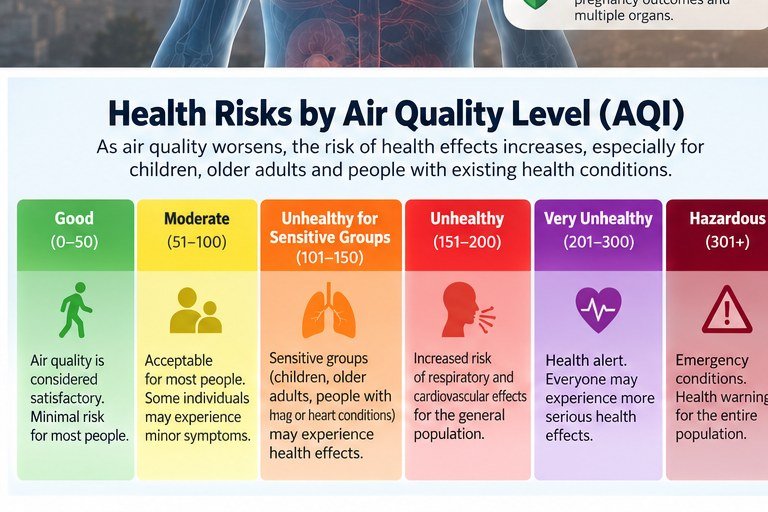
An Air Quality Index converts pollutant concentration information into a simpler numerical scale and health category. A higher AQI generally indicates greater pollution under the stated methodology, but AQI is not a single universal international measurement system. Countries and agencies can use different pollutants, concentration breakpoints, averaging periods and category definitions.
For that reason, an AQI value calculated under one national methodology should not automatically be treated as identical to the same number under another. On AirQualityIndex.org, read the named source and methodology together with the value. Our AQI Calculator and Air Quality Explained pages provide further context.
Who may be more vulnerable?
Air pollution can affect everyone, but susceptibility and exposure differ. Children, older adults, pregnant people, people with heart or lung disease, and people who work or exercise outdoors may require greater attention to local public-health advice. Communities with sustained higher exposure can also carry a disproportionate burden.
Individual medical circumstances vary. Anyone with a diagnosed condition should follow advice from their healthcare professional and local health authorities rather than relying on a website alone.
Short-term and long-term exposure
Short-term exposure can occur over hours or days during smog, wildfire smoke, dust events or atmospheric stagnation. Long-term exposure is repeated exposure over months or years. Scientific evidence links both acute and chronic particle exposure with health effects, although the strength of evidence and biological mechanisms differ by outcome.
A single current AQI reading therefore cannot describe a person's cumulative air-pollution exposure or lifetime health risk.
Practical ways to reduce exposure
- Check current local air quality before prolonged or strenuous outdoor activity.
- When pollution is elevated, consider reducing the duration or intensity of outdoor exertion, particularly if you are in a sensitive group.
- Pay attention to the dominant pollutant; particulate pollution, ozone and carbon monoxide are different exposure situations.
- Follow local public-health and emergency guidance during wildfires, severe smog, dust storms or industrial incidents.
- Manage indoor sources as well as outdoor infiltration. Appropriate filtration may reduce indoor particle concentrations, while smoking and poorly vented combustion can worsen indoor air.
- Follow your healthcare plan if you have a diagnosed heart or lung condition.
Measured data, modelled data and personal exposure are different
A monitoring station measures conditions at a particular location. Atmospheric models estimate conditions across wider areas. Neither is identical to personal exposure, which depends on where a person spends time, indoor conditions, commuting, occupation, ventilation and physical activity. AirQualityIndex.org therefore distinguishes monitoring observations, modelled information, forecasts and calculated AQI values wherever the source permits.
Scientific & technical references
These links lead to the originating institutions so readers can verify the evidence and methodology.
- WHO — Global Air Quality Guidelines ↗
- WHO — Air Quality and Health ↗
- WHO — Types of Pollutants and Health Impacts ↗
- U.S. EPA — Health Effects of Particulate Matter ↗
- U.S. EPA — Particle Pollution Exposure ↗
- U.S. EPA — Ground-level Ozone ↗
- U.S. EPA — Nitrogen Dioxide ↗
- IARC — Outdoor Air Pollution Evaluation ↗
- European Environment Agency — Air Pollution ↗
- NCBI Bookshelf — WHO AQG Evidence Resources ↗
Health information notice
AirQualityIndex.org provides environmental information and general educational material. It does not provide medical advice, diagnosis or treatment. If you have symptoms or a medical condition, consult an appropriately qualified healthcare professional. For emergencies, follow local emergency services and public-health instructions.